A flickering light above your checkout counter or a tripped breaker in your server room can feel like a minor annoyance. But for Delaware business owners, these small signs often point to something far more serious underneath. Workplace electrical fires cause 70,000 to 80,000 incidents per year across the U.S., with property losses reaching $2.4 billion annually, and electrical distribution or lighting faults are responsible for 12% of all non-residential fires. Delaware law requires licensed electricians for commercial electrical repairs, and skipping that step puts your business, your employees, and your insurance coverage at risk. This guide walks you through everything you need to know to handle electrical repairs the right and legal way.
Table of Contents
- Understanding code requirements and legal obligations
- Before you begin: Preparing for electrical repairs
- Step-by-step: Code-compliant electrical repairs
- After the repair: Inspection, documentation, and ongoing safety
- The real world: Why cutting corners on electrical repairs costs more
- Get code-compliant commercial electrical repair help
- Frequently asked questions
Key Takeaways
| Point | Details |
|---|---|
| Always hire licensed electricians | Delaware law requires licensed pros for commercial electrical repairs and compliance. |
| Prepare for safe repairs | Have all permits, documents, and a qualified team ready before work begins. |
| Follow code every step | Every repair must meet NEC, OSHA, and local inspection requirements to avoid fines or hazards. |
| Document and inspect post-repair | Keep official documentation and confirm inspections for insurance and liability protection. |
Understanding code requirements and legal obligations
Delaware follows the 2020 NEC with amendments effective since September 1, 2021, which sets the standard for all commercial electrical work in the state. The National Electrical Code, or NEC, is the nationally recognized benchmark for safe electrical installation. Delaware’s local amendments adjust certain requirements to fit the state’s specific conditions, but the core message is simple: commercial electrical repairs must be done by licensed electricians.
The Delaware Board of Electrical Examiners oversees licensing and compliance for all electrical contractors operating in the state. Local county and city inspectors then verify that completed work meets code before a business can resume full operations. If you’re operating in Wilmington, working with a Wilmington electrical contractor who knows both the state and local amendment layers saves you from costly inspection failures.
Many business owners assume that replacing a light switch or resetting a breaker doesn’t require a permit. The distinction matters. Routine maintenance tasks like changing a light bulb or resetting a tripped breaker generally don’t trigger a permit requirement. But any repair that involves opening a panel, replacing wiring, adding a circuit, or modifying an existing installation almost always does. When in doubt, the safe and legal default is to check with your local electrical inspector before starting any work.
Here’s a quick comparison of what does and doesn’t typically require a permit and licensed contractor:
| Task | Permit required? | Licensed electrician required? |
|---|---|---|
| Replacing a light bulb | No | No |
| Resetting a tripped breaker | No | No |
| Replacing an outlet or switch | Usually yes | Yes |
| Adding or extending a circuit | Yes | Yes |
| Panel repair or upgrade | Yes | Yes |
| Wiring for new equipment | Yes | Yes |
“Unlicensed electrical work on commercial properties in Delaware can void your insurance policy, expose you to significant fines, and in the event of a fire or injury, leave your business personally liable for damages.”
The financial risk of DIY or unlicensed commercial repairs is not theoretical. Insurance adjusters specifically investigate the source of electrical failures when claims are filed. If unlicensed work is discovered, claims can be denied in full. You can find a detailed breakdown of your obligations in this Delaware electrical repair guide.
Before you begin: Preparing for electrical repairs
With a grounding in code obligations, you’re ready to prepare for repairs. Good preparation is what separates a smooth repair project from one that drags on, triggers failed inspections, or creates new hazards.
Start by gathering your documentation. You’ll want your electrical panel schedule (the label chart inside your panel door that identifies each breaker), any recent inspection reports, and records of past electrical work done on the property. These documents help your electrician understand the existing system quickly and spot deviations from code that could cause problems during an inspection.
Next, verify that the electrician you’re hiring holds a current Delaware electrical license and carries both general liability insurance and workers’ compensation coverage. You can verify licenses through the Delaware Division of Professional Regulation. Don’t skip this step. A contractor who can’t provide proof of both is a serious financial risk if something goes wrong on your property.
OSHA’s most frequently cited standards for 2025 include Lockout/Tagout (LOTO) under 1910.147 as a top violation. OSHA defines a “qualified person” as someone who has training and experience with electrical systems and understands the hazards involved. Your maintenance staff, no matter how capable, likely does not meet this definition for energized commercial electrical work. NFPA 70E also sets arc-flash personal protective equipment (PPE) requirements for anyone working near energized conductors.
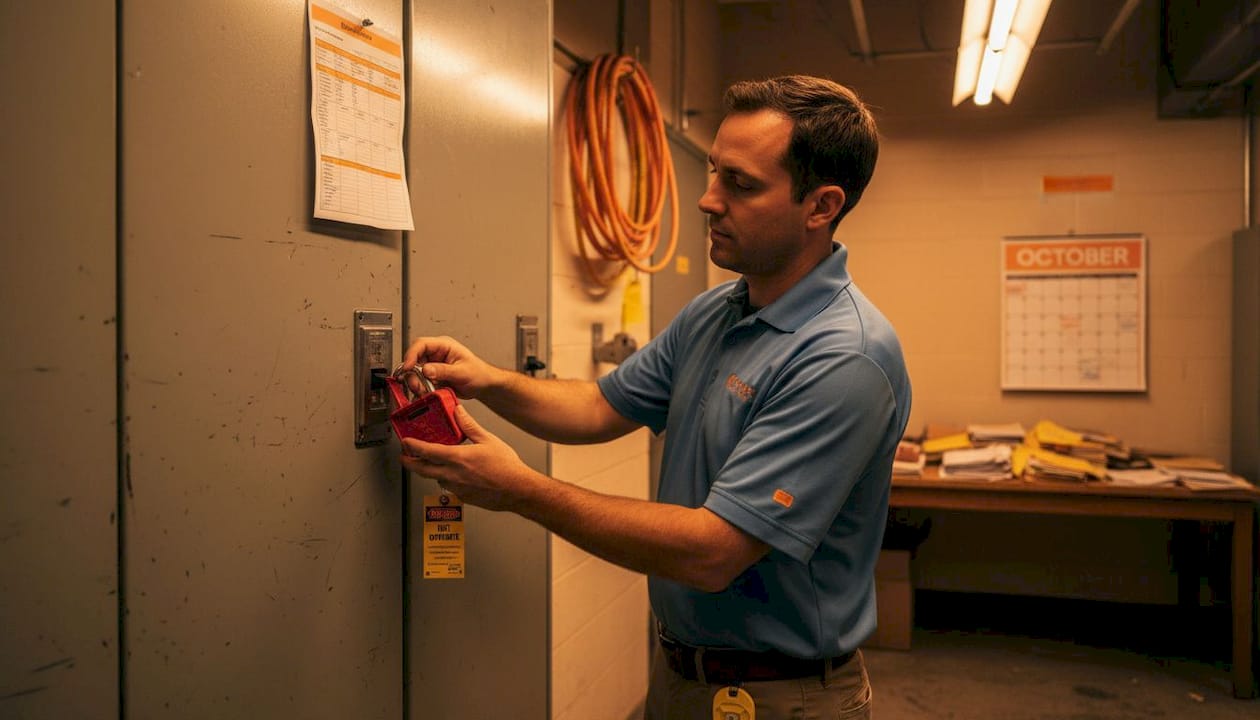
Here’s a clear breakdown of who can do what:
| Role | Permitted tasks |
|---|---|
| Business owner | Report issues, coordinate scheduling, review documentation |
| Maintenance staff | Replace light bulbs, reset breakers, report faults |
| Licensed electrician | All wiring, panel, circuit, and installation work |
| Certified OSHA-qualified person | Energized work with proper PPE and LOTO procedures |
Before work begins, make sure you have:
- Current electrical panel schedule
- Copies of previous permits and inspection reports
- Verified contractor license and insurance certificates
- A scheduled date for city or county inspection post-repair
- A clear list of all known electrical faults
Pro Tip: Ask your electrician to review your commercial maintenance checklist before the repair visit. Addressing multiple smaller issues in one visit is far more cost-effective than scheduling separate service calls.
Permits aren’t just paperwork. They trigger inspections, and inspections protect you. When an inspector signs off on a repair, you have official documentation that the work meets current code. That documentation is exactly what an insurance adjuster or attorney needs to see if something goes wrong later.
Step-by-step: Code-compliant electrical repairs
With solid preparation, it’s time to see what a proper commercial repair actually involves. Here’s what to expect, step by step, and how to stay safe throughout the process.
-
Initial assessment. Your licensed electrician arrives, reviews your panel schedule and documentation, and visually inspects the fault area. They identify the scope of work, confirm permit requirements, and provide a written estimate.
-
Permit application. For repairs that require a permit, your contractor submits the application to the local building or electrical inspection office before any work begins. Starting work without an approved permit is a code violation in itself.
-
Lockout/Tagout procedure. Before touching any wiring, the electrician de-energizes the relevant circuit or panel section and applies LOTO locks and tags. This prevents anyone from accidentally restoring power while work is in progress. It’s not optional; it’s required by OSHA 1910.147.
-
Verification of de-energized state. Using a non-contact voltage tester or clamp meter, the electrician verifies the circuit is dead. No assumption. Always test.
-
Repair or replacement. The electrician completes the repair, which may involve replacing damaged wire, installing a new breaker, or upgrading a component to meet the current NEC standard.
-
Rough-in inspection (if required). For larger projects, an inspector must review exposed wiring before walls or ceilings are closed. Your electrician will coordinate this timing.
-
Restoration and final inspection. Power is restored, the system is tested under load, and a final inspection is scheduled with the local authority. When the inspector signs off, you receive a certificate of completion.
-
Documentation handoff. Your contractor provides all permits, inspection tags, and invoices. Store these with your permanent property records.
Overloaded circuits account for 40% of workplace electrical fires. If your repair involves a circuit that has been tripping repeatedly, your electrician should also assess the overall load on that branch circuit and determine whether a dedicated circuit or panel upgrade is needed.
Water damage adds an important layer of complexity. Per NEC 110.26(F)(1) requirements, electrical systems that have been exposed to floodwater typically require full replacement rather than repair. This is one of those code requirements that surprises many business owners. Spot repairs on water-damaged systems are not code-compliant. Your electrician must de-energize the system first, pull appropriate permits, and pass both rough-in and final inspections before power can legally be restored.
Pro Tip: Schedule electrical repairs during off-hours or over a weekend when possible. Discuss the timeline with your electrician in advance so you can notify employees and customers about any planned outages. A one-hour planned shutdown beats an emergency outage that lasts a full business day.
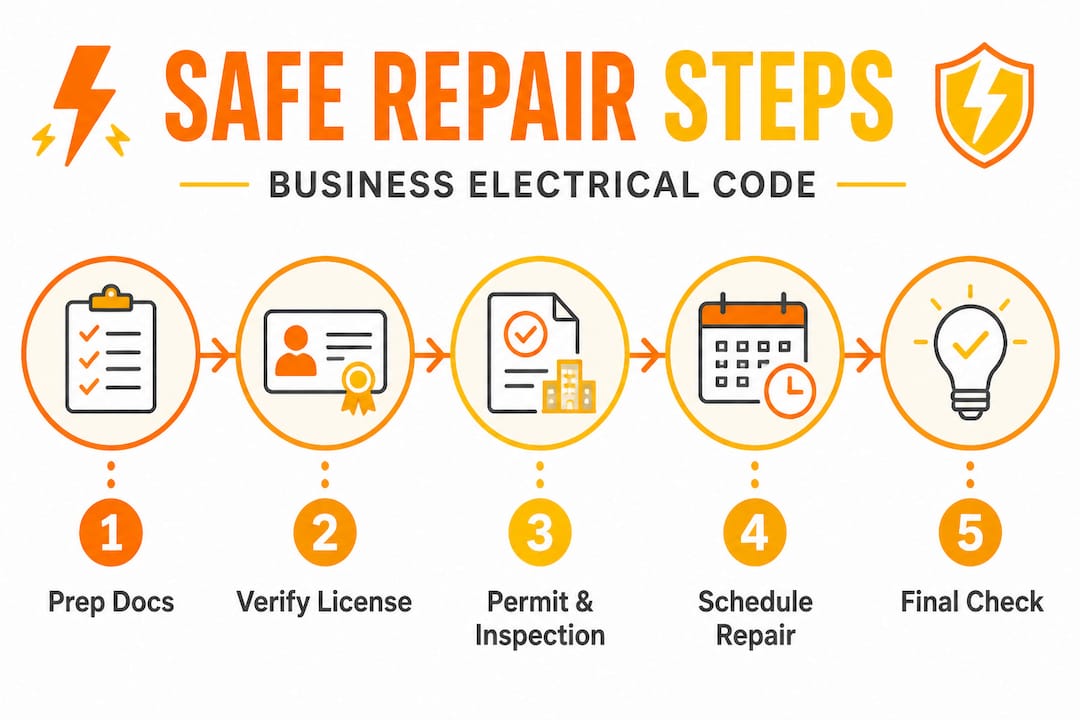
For help troubleshooting electrical repairs or scoping a commercial project, a licensed contractor can walk you through every step before work begins.
After the repair: Inspection, documentation, and ongoing safety
Completing a repair isn’t the end. What you do after the work is finished is just as important as the repair itself, especially when it comes to protecting your business from liability.
Post-repair inspections are required by code. Under NEC Article 110.27, electrical systems must be inspected before they are restored to service after significant work. This isn’t just a formality. Inspectors catch issues that even experienced electricians can miss under time pressure. If a repair fails inspection, you’ll have the chance to correct it before it becomes a safety hazard or insurance problem.
Here’s your post-repair documentation checklist:
- Inspection certificate or sign-off sheet from the local electrical inspector
- Contractor invoice with a description of the work performed
- Permits issued for the repair (keep the original, not just a copy)
- Inspection tags if applied to panels or equipment
- Updated panel schedule if any circuits were added or relabeled
- Photos of the completed work taken before walls or ceilings were closed
“Your electrical records are your legal shield. In any insurance claim, fire investigation, or liability dispute, the first thing investigators look for is documentation proving the work was permitted, performed by a licensed contractor, and inspected.”
Work with a trusted Delaware electrical contractor who provides clear documentation at the close of every job. A contractor who doesn’t offer proper paperwork is saving themselves time at your expense.
Beyond individual repairs, establish a routine electrical safety schedule for your business. Monthly visual checks of panels, outlets, and cords catch problems early. Annual professional inspections give you a full picture of your system’s health. Keep a service log with dates, findings, and actions taken. This ongoing relationship with your electrician means that when something does go wrong, they already understand your system and can respond faster.
The real world: Why cutting corners on electrical repairs costs more
After walking through the entire process, let’s take a step back and be direct about something we see regularly in commercial electrical work: the businesses that try to save money by cutting corners almost always end up spending more.
Here’s what typically happens. A building owner hires an unlicensed handyman to replace a worn panel breaker. The work looks fine. No one gets hurt. But two years later, a faulty connection causes a small arc fire in the wall. The insurance company investigates and finds no permit, no inspection, and no licensed contractor on record. The claim is denied. The business owner pays out of pocket for structural repairs, equipment replacement, and temporary closure costs.
Rare code edge cases catch people off guard too. Most business owners don’t know that electrical faults in non-residential buildings are responsible for $2.4 billion in property damage annually, or that a flood-damaged electrical system requires full replacement, not patching. They also don’t know about HVAC outdoor GFCI exemptions that expire in September 2026, after which previously exempt equipment must be brought into compliance. Missing a deadline like that isn’t ignorance; it’s a code violation with real consequences.
We’ve also seen businesses face OSHA fines because maintenance staff performed work on energized circuits without proper LOTO procedures or PPE. The fine itself can reach tens of thousands of dollars. Add in legal fees, worker injury claims, and the reputational damage of a serious workplace incident, and you can see why the upfront cost of hiring a licensed electrician looks very reasonable by comparison.
The most expensive electrical repair is always the one done wrong the first time. Investing in safe, code-compliant solutions from the start is the decision that protects your business, your people, and your bottom line for years to come.
Get code-compliant commercial electrical repair help
If this guide has made one thing clear, it’s that commercial electrical repairs in Delaware require professional expertise, proper permits, and thorough documentation to protect your business from fire risk, OSHA violations, and insurance gaps.
At Conductive Electrical Contracting, we’ve been serving business owners across Delaware and neighboring Maryland for over 20 years. Our licensed electricians handle commercial electrical repairs of every scale, from tripped breakers and faulty outlets to full panel replacements and water-damaged system overhauls. Every job comes with proper permits, code-compliant workmanship, and clear documentation. We also offer licensed repairs and installations for businesses adding new equipment, expanding operations, or upgrading aging systems. Check out our current electrical repair specials and contact us today for a fast, no-obligation estimate.
Frequently asked questions
Are business owners in Delaware allowed to perform their own electrical repairs?
No. Under Delaware’s 2020 NEC adoption effective since September 2021, commercial electrical repairs must be performed by a licensed electrician to ensure code compliance and legal protection.
What documentation should I keep after an electrical repair?
Keep permits, contractor invoices, inspection certificates, and updated panel schedules. Per NEC Article 110.27, inspections must be completed before systems are restored, and those records are your proof of compliance.
What is the most common cause of business electrical fires?
Overloaded circuits cause approximately 40% of workplace electrical fires. If a circuit breaker trips repeatedly, that’s an early warning sign that needs immediate professional attention.
When are inspections required for repairs in commercial buildings?
Most repairs involving wiring, panel work, or circuit additions require a permit and a final inspection by a local electrical inspector before the system is returned to service.
How does OSHA impact electrical repairs in Delaware businesses?
OSHA requires that only qualified persons perform energized work, with Lockout/Tagout procedures and arc-flash PPE in place. LOTO violations under standard 1910.147 are among the most frequently cited OSHA infractions across all industries.