Most people assume power surges are rare events tied to dramatic lightning storms. The reality is far more unsettling: your home or small business may experience over 20 small surges every single day, most of them completely invisible to you. These minor voltage spikes quietly degrade your appliances, wiring, and electronics over months and years before anything visibly fails. By the time you notice a dead refrigerator or a fried circuit board, the damage has been building for a long time. This article explains exactly what power surges are, what triggers them, how they harm your property, and what protection actually works.
Table of Contents
- What is a power surge and why does it matter?
- What causes power surges in Delaware homes and businesses?
- How do power surges damage your devices and wiring?
- Effective surge protection: What works (and what doesn’t)
- Whole-home protection vs. plug-in devices: What’s best for Delaware?
- Why most people overlook surge risk and what to do differently
- Get expert surge protection for your Delaware home or business
- Frequently asked questions
Key Takeaways
| Point | Details |
|---|---|
| Surges are frequent | Minor power surges strike Delaware homes daily and cumulative damage adds up fast. |
| Damage can be hidden | Surges may fry circuits instantly or quietly weaken wiring and appliances over months. |
| Not all protection is equal | Only certified surge protectors with proper VPR and joule ratings give true defense. |
| Whole-home protection is best | Only whole-home SPDs defend your entire wiring and large appliances, not just plug-in devices. |
| Professional help matters | Local electricians ensure correct installation and ongoing protection for ultimate peace of mind. |
What is a power surge and why does it matter?
A power surge is a sudden, brief spike in electrical voltage that pushes current above the safe level your home’s wiring and devices are designed to handle. In the United States, standard household voltage runs at 120 volts. A surge can push that number into the hundreds or even thousands of volts within a fraction of a second. That spike is enough to overwhelm the circuits inside your appliances, electronics, and even the wiring inside your walls.
Understanding reducing static electricity is one small piece of the larger electrical safety picture, but surges represent a much more significant and frequent threat. They are not just a storm-season problem. They happen year-round, often triggered by everyday events inside and outside your home.
Here is a quick breakdown of the most common surge causes and their typical voltage impact:
| Cause | Typical voltage spike | Frequency |
|---|---|---|
| Lightning strike (direct) | Thousands of volts | Rare |
| Utility grid switching | Hundreds of volts | Weekly |
| Large appliance cycling | 10 to 100+ volts | Daily |
| Downed power lines | Hundreds of volts | Occasional |
| Faulty wiring | Variable | Ongoing |
The damage surges cause ranges from immediate and obvious to slow and hidden. A single large surge can fry a circuit board instantly. Dozens of small daily surges gradually weaken the insulation on your wiring, shorten the lifespan of your appliances, and increase your fire risk over time. The Insurance Information Institute reported that lightning caused $1.04 billion in U.S. homeowners insurance claim payouts in 2024, with an average claim of $18,641. That number only reflects reported lightning events. It does not capture the thousands of smaller surge-related losses that go unclaimed or unnoticed.
“Most homeowners only think about surge protection after something expensive stops working. By then, the damage is already done.”
Knowing how to survive summer power outages is helpful, but preventing surge damage before an outage even occurs is a smarter long-term strategy.
What causes power surges in Delaware homes and businesses?
Knowing what a power surge is, let’s look at what actually causes these spikes, both the obvious and hidden sources. Delaware’s mix of coastal weather, aging infrastructure in older neighborhoods, and a high density of small businesses makes surge risk a real and present concern for local property owners.
Here are the five main sources of power surges you need to know:
-
Lightning strikes. Even a lightning bolt that hits a tree or utility pole a block away can send a massive voltage spike through your power lines and into your home. Direct strikes are rare, but nearby strikes cause surges far more often than most people realize.
-
Utility grid switching. Delmarva Power and other utility providers regularly switch between circuits to manage load and perform maintenance. Each switch can send a brief but significant voltage spike through the lines feeding your property.
-
Large appliance cycling. Every time your HVAC system, refrigerator, or washing machine kicks on or off, it draws a burst of power that can create a small surge. These happen dozens of times a day and are one of the leading causes of gradual appliance wear.
-
Wiring issues and overloaded circuits. Older homes in Wilmington and surrounding Delaware communities often have wiring that was not designed for today’s electrical loads. Loose connections, overloaded circuits, and deteriorating insulation all create conditions where internal surges occur regularly.
-
Downed power lines. Whether from a storm, a car accident, or a falling tree, downed lines can send unpredictable voltage spikes into homes and businesses connected to that section of the grid.
The cumulative effect of these daily triggers is significant. Homes see 20 or more small surges per day, and the damage adds up silently. Making sure your electrical system is in good shape through safe electrical repairs is one of the best ways to reduce your internal surge risk before adding any external protection.
Key takeaway: The most dangerous surges are not always the biggest ones. It is the steady accumulation of small, unnoticed spikes that quietly destroys expensive equipment over time.
How do power surges damage your devices and wiring?
Now that you know where surges originate, it is essential to see precisely how they affect everything plugged into your home or business. The damage happens in two distinct ways: immediate burnout and gradual degradation. Both are costly. Both are largely preventable.
Immediate burnout happens when a large surge, like one caused by a nearby lightning strike or a major utility event, sends enough excess voltage through a circuit to destroy it instantly. The delicate microchips inside smart TVs, computers, and modern appliances simply cannot handle that kind of spike. You plug something in after a storm and it is completely dead. That is immediate burnout.

Gradual degradation is the more common and more insidious problem. Each small surge slightly weakens the insulation on wiring and the components inside your devices. Think of it like bending a paperclip back and forth. Each bend does a little damage. Eventually, it snaps. Your appliances and wiring work the same way. After months of daily micro-surges, a refrigerator compressor fails, a dishwasher control board stops responding, or a circuit breaker starts tripping without an obvious cause.
Here is what gradual surge damage looks like in practice:
- Appliances that seem fine but stop working months after a major storm
- Electronics that become unreliable or behave erratically
- Light bulbs that burn out faster than they should
- Circuit breakers that trip more frequently over time
- Wiring insulation that becomes brittle and increases fire risk
The fire risk deserves special attention. Damaged wiring insulation can arc, meaning electricity jumps across a gap in the wire, generating intense heat. That heat can ignite surrounding materials inside your walls before any smoke detector has a chance to alert you. The average lightning-related claim of $18,641 often reflects fire and structural damage, not just appliance replacement.
Pro Tip: If your home has experienced a major surge event, such as a nearby lightning strike or a utility outage, have a licensed electrician inspect your wiring before assuming everything is fine. Hidden damage inside walls is far more dangerous than a dead appliance. Check out our Delaware surge protection guide for more detail on post-surge inspections.
Effective surge protection: What works (and what doesn’t)
Understanding the damage surges cause, let’s explore what really counts for protection and how to avoid costly mistakes. The term “surge protector” gets used loosely, and that creates real confusion for homeowners and business owners trying to make smart purchasing decisions.
A true surge protector, technically called a Surge Protective Device (SPD), works by using components called Metal Oxide Varistors (MOVs) or gas discharge tubes to detect excess voltage and divert it safely to the ground wire before it reaches your devices. SPDs use MOVs and gas discharge tubes to clamp voltage spikes at a safe threshold, typically between 330 and 400 volts for home use. Anything above that threshold gets redirected away from your equipment.
Here is how to read surge protector specs so you can make an informed choice:
| Spec | What it means | What to look for |
|---|---|---|
| Joule rating | How much total energy the SPD can absorb over its lifetime | 1,000 to 2,000+ joules for home use |
| VPR (Voltage Protection Rating) | The clamped voltage level passed to your devices | 330 to 400V or lower |
| UL 1449 certification | Independent safety testing standard | Required, not optional |
| Indicator light | Shows whether MOVs are still functional | Highly recommended |
A joule rating of 1,000 to 2,000 is the minimum benchmark for protecting home electronics, and UL 1449 certification is a non-negotiable standard that confirms the device has been independently tested. VPR of 400V or lower is preferred, meaning less excess voltage reaches your equipment during a surge event.
The biggest mistake most people make is confusing a basic power strip with a surge protector. A standard power strip simply adds outlets. It provides zero surge protection. If it does not say “surge protector” and carry a joule rating and UL 1449 certification, it is not protecting anything.
Pro Tip: MOVs inside surge protectors wear out over time. Even if your surge protector looks fine and the power light is on, it may no longer be offering real protection after a major surge event. Replace units every two to three years, or immediately after a significant surge.
For a deeper look at your options, visit our whole house surge protection page or our detailed Delaware surge protection guide for local recommendations.
Whole-home protection vs. plug-in devices: What’s best for Delaware?
Once you know how protection should work, the final decision is choosing the right type. Let’s compare the real-world benefits of whole-home versus plug-in devices so you can make the right call for your property.
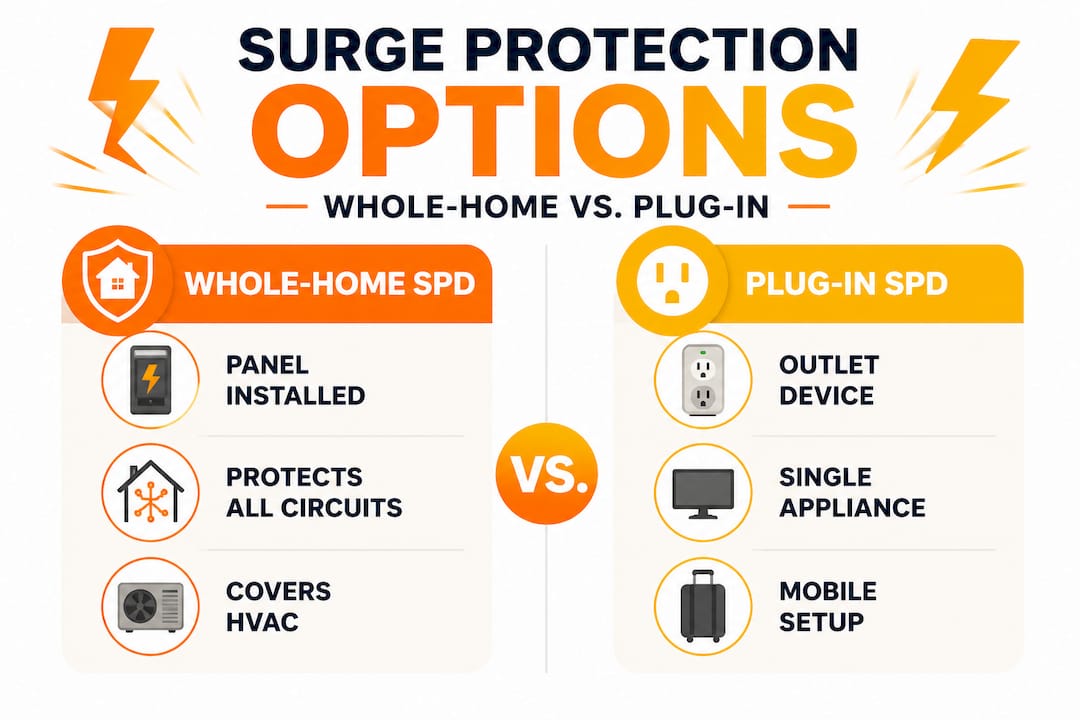
Whole-home surge protection is installed directly at your main electrical panel. It protects every circuit in your home simultaneously, including your HVAC system, water heater, refrigerator, and any hardwired appliances that a plug-in device simply cannot reach. For Delaware homeowners with central air conditioning, electric heat pumps, or well pumps, this is critical. Those systems are expensive to replace and completely unprotected by any plug-in device.
Plug-in surge protectors are point-of-use devices. They protect only the equipment plugged directly into them. Your TV, computer, and gaming console can be well-protected while your HVAC unit remains completely exposed to the same surge event.
Here is a direct comparison:
| Feature | Whole-home SPD | Plug-in SPD |
|---|---|---|
| Covers HVAC and hardwired appliances | Yes | No |
| Covers all circuits at once | Yes | No |
| Requires professional installation | Yes | No |
| Cost | Higher upfront | Lower upfront |
| Best for | Full property protection | Individual device protection |
An important nuance: MOVs degrade irreversibly after repeated surges, and this applies to both whole-home and plug-in units. Neither type lasts forever. Both need to be monitored and eventually replaced.
Pro Tip: The best strategy for Delaware homeowners and small business owners is a layered approach. Install a whole-home SPD at the panel to handle large surges, then use quality plug-in SPDs at your most sensitive equipment for a second line of defense. This combination gives you the broadest possible coverage.
For small businesses in Delaware with significant equipment investments, servers, point-of-sale systems, or specialized machinery, whole home surge protection installed by a licensed electrician is not a luxury. It is a practical business expense that protects far more than it costs.
Why most people overlook surge risk and what to do differently
Here is something we have seen repeatedly over more than 20 years of electrical work in Delaware: homeowners only call about surge protection after something expensive has already failed. A refrigerator dies, a computer gets fried, or worse, a small electrical fire starts inside a wall. Then the conversation about surge protection begins.
The uncomfortable truth is that the daily, invisible surges are doing more cumulative damage to your property than the one dramatic lightning strike you have been mentally preparing for. People fixate on joule ratings when shopping for protection, assuming a higher number always means better protection. But joule rating indicates lifespan, not per-surge performance. A device with 2,000 joules but a poor VPR still lets too much voltage through to your equipment. UL 1449 certification and a VPR at or below 400V matter more than a big joule number on the box.
The mindset shift we encourage every Delaware homeowner and business owner to make is this: treat surge protection as essential infrastructure, not an optional accessory. You would not skip installing a smoke detector because fires are rare. Surge damage is not rare. It is happening every day, quietly, inside your walls and appliances.
Pairing surge protection with a broader commitment to year-round electrical safety tips is the most effective way to reduce your overall risk. Have your panel inspected, address any wiring concerns, and install layered surge protection before you have a reason to regret not doing it sooner.
Get expert surge protection for your Delaware home or business
If this article has made one thing clear, it is that surge protection is not a one-size-fits-all purchase you make at a hardware store. Effective protection requires the right equipment, properly installed, matched to the specific needs of your home or business.

At Conductive Electrical Contracting, we have been protecting Delaware homes and small businesses from surge damage for over 20 years. We install whole-house surge protection systems, inspect wiring for hidden surge damage, and help you build a layered protection strategy that actually works. Whether you need a full whole house surge protection installation, routine electrical repairs, or just want to know where your property stands, we are ready to help. Check out our current electrical specials for money-saving offers on surge protection and other services. Contact us today for a professional assessment.
Frequently asked questions
How do I know if a power surge has damaged my appliances?
Look for sudden appliance failures, unusual noises, or devices that stop working after a storm or outage. Because surges can cause immediate or delayed failures, some damage may not show up until weeks or months after the event.
Are most power strips also surge protectors?
No. Most power strips only provide extra outlets and offer zero surge protection. Only devices specifically labeled as surge protectors with a joule rating and UL 1449 certification provide actual protection.
Does homeowner’s insurance in Delaware cover power surge damage?
Insurance typically covers lightning-related surges, but deductibles apply and coverage for non-lightning surge types varies by policy. Review your policy carefully and consider whether your deductible makes small claims practical.
How should I choose the right surge protector for my home?
Choose protectors with UL 1449 certification and VPR at or below 400V, and a minimum joule rating of 1,000 for home electronics. A whole-house unit installed at your panel offers the broadest protection for your entire property.
Recommended
- Whole House Surge Protection by Conductive Electric (2025)
- What Is Surge Protection? Essential Guide for Delaware Homes
- Protect your Delaware home: essential surge protection guide
- Conductive Electric: Summer Power Outage Survival in 2025
- Coastal Electrical Moisture Risks
- Residential Battery Backup – A&R Solar