Pool wiring is one of the most regulated and unforgiving electrical projects a Delaware homeowner can face. Get it wrong, and you’re looking at shock hazards, failed inspections, voided homeowner’s insurance, and serious liability. The National Electrical Code (NEC) Article 680 sets the national baseline, but Delaware enforces its own permit and inspection requirements on top of that. Whether you’re installing a new pool or upgrading an existing one, understanding what’s required before the first wire is run can save you thousands of dollars and, more importantly, keep your family safe. This guide walks you through every critical step.
Table of Contents
- Understand code requirements and permits
- Install ground-fault circuit interrupters (GFCIs) for safety
- Master bonding and grounding to prevent shocks
- Proper conduit, wiring, and equipment placement
- What most pool wiring guides miss: overlooked risks and hard-earned lessons
- Ensure your pool wiring meets Delaware’s highest standards
- Frequently asked questions
Key Takeaways
| Point | Details |
|---|---|
| Permit and code compliance | Delaware law requires permits and strict adherence to NEC Article 680 for any new or upgraded pool wiring. |
| Mandatory GFCI protection | All pool-related circuits and outlets near water must have GFCI protection for effective shock hazard prevention. |
| Bonding and grounding | Both bonding and grounding are required to neutralize electrical differences and ensure safe operation. |
| Correct wiring placement | Follow required distances and conduit types for outlets and wiring to comply with safety codes and prevent accidents. |
Understand code requirements and permits
Before any wiring touches your pool equipment, you need a permit. In Delaware, pool electrical installations require permits for any pool over 24 inches deep, and that includes many above-ground models people assume are exempt. This isn’t optional paperwork. It triggers a mandatory inspection process that protects you, your guests, and your home’s resale value.
Delaware adopts the NEC Article 680 for swimming pools, with local permits and inspections required for all pool electrical installations. Article 680 is the most specific electrical code in the NEC. It covers everything from where wiring can run to which devices need special protection, and it exists because water and electricity together are extraordinarily dangerous.
Here’s what NEC Article 680 governs for your pool:
- GFCI protection on all branch circuits serving pool equipment
- Equipotential bonding connecting all metallic parts of the pool structure
- Approved wiring methods including conduit type and burial depth
- Minimum distances between electrical components and the water’s edge
- Lighting fixture specifications for underwater and above-water use
Inspections happen at two points: rough-in (before wiring is covered) and final (after all equipment is installed). Both must pass before you can legally use the pool’s electrical systems. Skipping this step doesn’t just put you at risk of electrical fires or shocks. It creates real problems when you try to sell your home. Buyers’ home inspectors and title companies routinely flag unpermitted work, and you could be forced to tear out and redo everything at your own expense.
“Code compliance isn’t just about following rules. It’s the difference between a pool that’s enjoyed for decades and one that becomes a liability.”
Your homeowner’s insurance may also deny claims related to electrical incidents if unpermitted work is discovered. Reviewing Delaware’s residential wiring requirements before you start ensures you know exactly what’s expected and what to ask your electrician.
Install ground-fault circuit interrupters (GFCIs) for safety
With permits covered, the next step is understanding how electrical safety devices like GFCIs protect you and your family. A GFCI, or ground-fault circuit interrupter, monitors the flow of electricity through a circuit. The moment it detects even a tiny imbalance (as small as 5 milliamps) between outgoing and returning current, it shuts off power in about 1/40th of a second. Think of it as a trip wire for electricity. It reacts faster than a circuit breaker and much faster than any human nerve response.
GFCI protection is mandatory for all pool-related branch circuits rated 150V or less to ground and 60A or less, including receptacles within 20 feet of the pool edge, pumps, lights, and heaters. That covers nearly every outlet and piece of equipment near your pool.
| Equipment or location | GFCI required? | Distance from pool edge |
|---|---|---|
| Receptacles | Yes | 6 ft minimum, 20 ft GFCI zone |
| Pool pump motor | Yes | N/A (equipment-specific) |
| Underwater lighting | Yes | N/A (submersible rated) |
| Pool heater | Yes | N/A (equipment-specific) |
| Lighting outlets above pool | Yes | Within 20 ft zone |
Signs your GFCI may be failing include:
- The test button doesn’t trip the device
- The reset button won’t stay latched
- Outlets connected downstream lose power randomly
- You notice burn marks or discoloration on the outlet face
Review the specific pool wiring GFCI rules that apply to Delaware installations before purchasing equipment, since not all GFCI devices are rated for outdoor or wet locations.
Pro Tip: Test every GFCI near your pool once a month. Push the test button, confirm power cuts off downstream, then press reset. It takes 30 seconds and could save a life.
Master bonding and grounding to prevent shocks
Once safety devices are addressed, it’s critical to ensure the entire pool structure is free from dangerous voltage differences. Two terms come up constantly in pool electrical work: bonding and grounding. They sound similar but do very different jobs, and mixing them up leads to serious oversights.
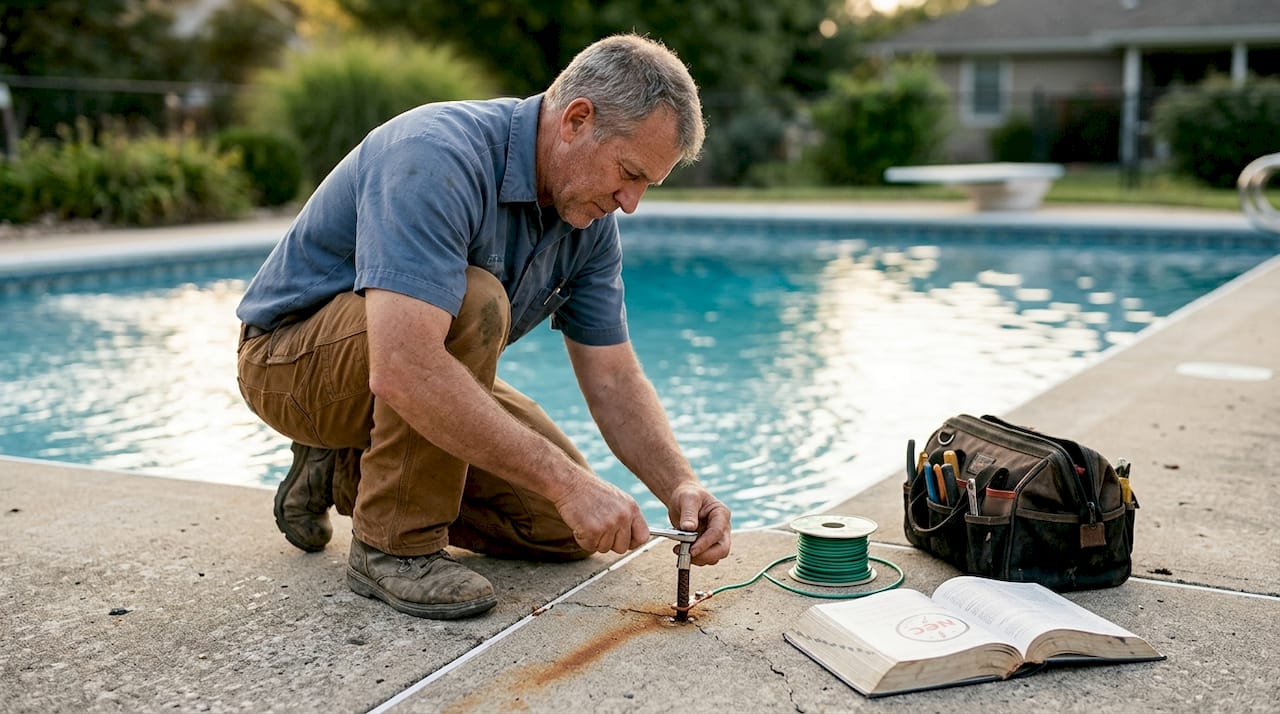
Bonding connects all metallic parts of the pool together so they share the same electrical potential. When everything is at the same voltage, no current flows between metal surfaces and a swimmer’s body. The shock you feel from touching a metal ladder in a poorly wired pool happens because two metal parts are at different voltages. Bonding eliminates that difference.
Grounding provides a physical path for fault current to travel safely to the earth. It protects the wiring system itself and works with your circuit breaker to shut down power during a fault.
| Feature | Bonding | Grounding |
|---|---|---|
| Purpose | Equalizes voltage between metals | Carries fault current to earth |
| Material | #8 AWG solid copper (continuous) | Copper conductor to ground rod |
| What it connects | Pool shell, ladders, pumps, lights | Equipment enclosures, panel |
| Protects against | Voltage gradient shock | Electrical faults and fire |
Equipotential bonding requires a continuous #8 AWG solid copper conductor connecting all metallic parts within 5 ft horizontally and 12 ft vertically of the pool, including the pool shell, ladders, pumps, and lights, with perimeter bonding extending 3 ft from the pool edge.
Key bonding connection points include:
- Pool shell reinforcing steel or copper grid
- All metal ladders and handrails
- Pump motors and filter housings
- Underwater lighting niches
- Metal water supply pipes within 5 ft of pool
Review pool bonding explained for a visual breakdown of connection points. Also check that your electrical panel can support the dedicated circuits pool equipment requires. For broader reference, the pool electrical standards from the National Pool Safety organization outline industry-wide expectations.
Pro Tip: The majority of electric shock drowning (ESD) incidents investigated annually trace back to incomplete or missing bonding, not failed GFCIs. Bonding is the silent guardian most homeowners never think about.
Proper conduit, wiring, and equipment placement
Having addressed risk reduction through electrical protection, let’s break down how to position wiring and outlets according to Delaware law. Where wires run and where outlets sit is just as important as what kind of wire you use.
Receptacles must be at least 6 ft from the pool edge; the equipment disconnect must be within sight (5 to 50 ft); underground wiring within 5 ft of the pool must use rigid or intermediate metal conduit, PVC, or RTRC conduit; no wiring is permitted to run under the pool.
Here are the steps to correctly install and inspect your pool wiring routing:
- Mark all setback zones. Measure and mark 5 ft, 6 ft, and 20 ft distances from the pool’s waterline before placing any conduit or outlets.
- Select approved conduit. Within 5 ft, use rigid metal conduit or Schedule 40/80 PVC. Beyond 5 ft, THWN-2 wire in conduit is standard for direct burial runs per approved copper wire types.
- Position the disconnect. Install a clearly labeled, lockable disconnect switch between 5 and 50 ft from the pool, with a direct line of sight to the equipment.
- Route wiring with burial depth in mind. Rigid metal conduit buries at 6 inches minimum; PVC conduit at 18 inches; direct burial cable at 24 inches.
- No flexible cords near water. Flexible cords are prohibited for permanent pool equipment connections. They wear, crack, and create shock hazards.
- Schedule rough-in inspection. Before backfilling trenches or covering conduit, have the inspector review the wiring route and conduit type.
Following safe wiring practices from the start prevents costly tear-outs later.
“Delaware’s commitment to pool electrical safety isn’t bureaucracy. It’s a direct response to preventable accidents that have happened in backyards just like yours.”
What most pool wiring guides miss: overlooked risks and hard-earned lessons
We’ve covered the rulebook, but what really happens when theory hits practice? Most online guides recite NEC requirements without acknowledging that Delaware adds its own inspection layers, and that local inspectors will catch mistakes generic guides never mention.
DIY videos are a particular problem. Many are filmed in states with looser local codes or older NEC editions. What passes inspection in one state may fail here. We’ve seen homeowners spend more correcting DIY pool wiring than they would have paid a licensed electrician in the first place.
There are also hidden hazards people overlook after installation. Delaware’s weather, from humid summers to freezing winters, accelerates corrosion on bonding connections and conduit fittings. Rust on a bonding clamp can break the continuous conductor path and create a shock risk without any visible warning. Critters chewing through conduit buried too shallow is another real issue we encounter regularly.
Not every electrician is qualified for pool work. Pool wiring is a specialty. Always ask whether the electrician has specific experience with NEC Article 680 installations and has completed inspected pool projects in Delaware.
Finally, many homeowners skip re-inspection after upgrades. Adding a new light, replacing a pump, or extending a circuit all require a permit and inspection. Treating an upgrade like maintenance is a mistake with real consequences.
Ensure your pool wiring meets Delaware’s highest standards
Reading about pool wiring best practices is a solid start, but putting them into practice requires the right hands on the work. Our team at Conductive Electrical Contracting brings over 20 years of licensed electrical experience to Delaware homeowners, including pool wiring projects inspected and approved to NEC Article 680 standards.

We handle everything from initial permits to final inspection, so you don’t have to navigate code requirements alone. Our electrical repair services cover both new installations and upgrades to existing pool wiring. We only perform licensed electrical work that is code-compliant and backed by our satisfaction guarantee. Check our current electrical specials for available savings on pool wiring and safety upgrades this season.
Frequently asked questions
Is a permit required for above-ground pools in Delaware?
Yes, Delaware requires permits for pools over 24 inches deep, and all associated pool wiring must pass electrical inspection regardless of whether the pool is in-ground or above-ground.
How far should outlets be from the pool edge?
Outlets must be at least 6 ft from the pool edge, and any receptacle within 20 feet must be GFCI-protected per NEC 680.22.
What’s the difference between pool bonding and grounding?
Bonding equalizes voltage between metals to prevent shock by eliminating potential differences, while grounding directs fault current safely to earth; both are required and serve completely separate functions.
Can underground pool wiring run directly under the pool?
No, wiring under the pool is prohibited, and any underground wiring within 5 ft of the pool must be installed inside rigid metal conduit, PVC, or RTRC conduit per NEC 680.11.