Most homeowners in Delaware face the same dilemma: something goes wrong with the wiring, and the first instinct is to search for a quick fix online. But electrical work is not like patching drywall. Delaware law requires that all significant repairs and installations be handled by licensed master or journeyman electricians, with permits pulled for most jobs. Getting this wrong can void your homeowner’s insurance, create fire hazards, and even result in fines. This guide breaks down the most common electrical repair types, what you can legally handle yourself, and how to find a qualified professional when you need one.
Table of Contents
- Understanding electrical repair categories: Safe vs. pro-only jobs
- Standard types of electrical repairs for homes and businesses
- Troubleshooting and diagnosis: Effective methods for lasting repairs
- Local regulations and permits: What Delaware requires for legal repairs
- The overlooked risk: Why even “simple” electrical repairs can mean big trouble
- Where to find safe, licensed electrical repair in Delaware
- Frequently asked questions
Key Takeaways
| Point | Details |
|---|---|
| Permit requirements | Most electrical work in Delaware needs a licensed pro and proper permits to avoid legal and safety issues. |
| Know your limits | DIY is limited to resets and simple fixture changes; most other repairs require expert handling. |
| Routine checks matter | Testing GFCIs monthly and scheduling regular system inspections can prevent dangerous failures. |
| Diagnose before repairing | Systematic troubleshooting finds root issues, saving time, money, and lowering fire risk. |
Understanding electrical repair categories: Safe vs. pro-only jobs
Not all electrical problems are created equal. Some issues are genuinely minor and carry low risk. Others look simple on the surface but involve live panels, aging wiring, or code-regulated components that require a licensed hand.
At the basic end of the spectrum, homeowners can safely handle a few tasks without a permit or professional help. These include:
- Replacing a burned-out light bulb or standard fixture cover
- Resetting a tripped circuit breaker (once, to confirm it holds)
- Replacing a like-for-like outlet cover plate
- Swapping a plug-in surge protector strip
- Testing and resetting a GFCI outlet using its built-in buttons
Anything beyond that list moves into territory that requires a licensed pro to avoid fire risk, shock hazard, and legal exposure. In Delaware, performing unlicensed electrical work for hire is illegal, and even homeowners working on their own property face strict limits. Panel upgrades, new circuit installations, rewiring projects, and anything involving the service entrance all require a permit and a licensed electrician.
There are real liability consequences here too. If unpermitted work causes a fire or injury, your homeowner’s insurance may deny the claim entirely. That is a financial risk most people do not fully consider until it is too late.
Before attempting any electrical task, always verify that the circuit is fully de-energized using a non-contact voltage tester. Never rely on a breaker label alone. Review our electrical repair safety checklist before starting any work, and know when to call for emergency electrical repair if the situation escalates.
Pro Tip: If a breaker trips repeatedly after you reset it, stop. A breaker that won’t stay on is telling you there is an active fault somewhere in the circuit. Resetting it again and again can cause overheating and start a fire.
Standard types of electrical repairs for homes and businesses
With professional boundaries in mind, let’s break down the leading repair types every owner should recognize.
These are the most common electrical repairs we handle for homeowners and small businesses across Delaware:
- Panel repairs and replacements. The electrical panel is the brain of your system. Panels last 25 to 50 years, but older panels from brands like Federal Pacific or Zinsco are known fire hazards and should be replaced regardless of age.
- Outlet and switch repairs. Dead outlets, loose connections, and faulty switches are among the most frequent service calls. These often signal deeper wiring issues behind the wall.
- Fixture wiring for lights and ceiling fans. Improper fixture wiring is a common source of flickering lights and intermittent power loss. It also poses a fire risk if connections are loose or undersized wire was used.
- Short circuit and arc fault remediation. Arc faults are particularly dangerous. Arc faults cause $1.3 billion in property damage every year in the U.S. Installing arc fault circuit interrupters (AFCIs) is now required by code in most living spaces.
- Surge protector and GFCI installation. Whole-home surge protection guards against voltage spikes from lightning or utility switching. GFCIs are required in kitchens, bathrooms, garages, and outdoor areas. Replace surge protectors every 3 to 5 years and test GFCIs monthly.
- Dedicated circuits for businesses and appliances. Commercial kitchens, medical offices, and home workshops often need dedicated 20-amp or higher circuits to handle equipment loads safely.
Stat to know: Arc faults are the leading cause of electrical fires in the U.S., responsible for over 28,000 home fires annually.
For a full breakdown of what we repair and install, visit our page on common electrical repairs to see the scope of work we handle across Delaware.
Troubleshooting and diagnosis: Effective methods for lasting repairs
Once a problem is identified, pinpointing the cause ensures it’s solved for good.
A proper electrical diagnosis is not guesswork. Licensed electricians follow a structured process that starts with documenting symptoms, isolating hazards, and then systematically narrowing down the fault location. This approach prevents the common mistake of replacing components that are not actually broken.
One of the most effective diagnostic methods is the half-split method. Instead of testing every point in a circuit one by one, the electrician tests the midpoint first, then cuts the remaining search area in half again based on the result. This dramatically reduces diagnostic time on complex circuits.
| Circuit size | Sequential testing time | Half-split method time | Time saved |
|---|---|---|---|
| 8-point circuit | ~8 tests | ~3 tests | 63% faster |
| 16-point circuit | ~16 tests | ~4 tests | 75% faster |
| 32-point circuit | ~32 tests | ~5 tests | 84% faster |
The tools that make this possible include digital multimeters (DMMs) for voltage and resistance readings, and clamp meters for measuring current without breaking the circuit. Systematic troubleshooting using these tools, combined with OSHA and NFPA 70E safety protocols, is the standard approach used by qualified electricians.
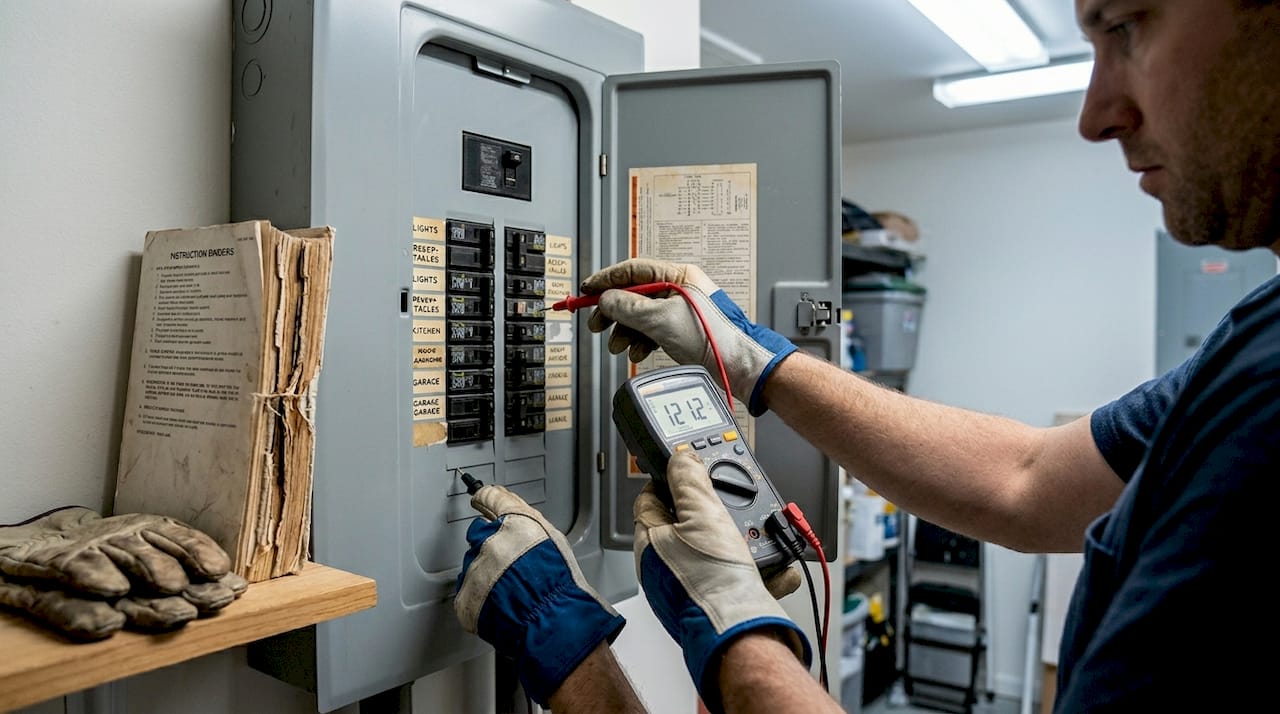
The four phases of a proper diagnosis are: symptom documentation, hazard isolation, fault localization, and repair with post-repair testing. Skipping any phase, especially post-repair testing, is how problems come back within weeks.
Pro Tip: If you have reset a breaker, replaced an outlet, and the problem persists, it is time to stop and call a professional. Repeated failures almost always point to a wiring fault or panel issue that basic replacements cannot fix.
For peace of mind, scheduling a professional electrical safety inspection gives you a documented baseline of your system’s condition and catches hidden faults before they become emergencies.
“The goal of troubleshooting is not just to restore power. It’s to understand why power was lost and ensure it cannot happen again under the same conditions.”
Local regulations and permits: What Delaware requires for legal repairs
No matter the repair, following Delaware’s strict rules ensures work is both safe and up to code.
Delaware adopts the National Electrical Code (NEC) with state-level amendments, and each county applies it through local enforcement. New Castle, Kent, and Sussex counties each have their own inspection offices, so the permit process can vary slightly depending on where your property is located.
Here is how the licensing tiers break down in Delaware:
- Apprentice electrician: Works under direct supervision. Cannot pull permits or work independently.
- Journeyman electrician: Licensed to perform most electrical work independently under a master’s oversight.
- Master electrician: Holds full licensing authority, can pull permits, and is responsible for code compliance on a job.
Homeowners are allowed to perform limited electrical work on their own primary residence, but the rules are strict. Permits are mandatory for panel work, new circuits, and service upgrades, and the work must pass inspection. Rental properties and commercial buildings are completely off-limits for unlicensed DIY work.
| Repair type | Homeowner allowed? | Permit required? | Licensed electrician required? |
|---|---|---|---|
| Replace outlet cover | Yes | No | No |
| Replace GFCI outlet | Yes (own home) | No | Recommended |
| Add new circuit | No | Yes | Yes |
| Panel upgrade | No | Yes | Yes (Master) |
| Rewiring project | No | Yes | Yes (Master) |
| Commercial repair | No | Yes | Yes |
The consequences of skipping permits go beyond fines. If unpermitted work is discovered during a home sale, you may be required to tear out and redo the work at your expense. For Delaware wiring upgrades and anything requiring a permit, working with licensed electrician services protects your investment and your safety.
The overlooked risk: Why even “simple” electrical repairs can mean big trouble
Here is something we have seen repeatedly over more than 20 years in this business: the jobs that look the easiest are often the ones hiding the most serious problems.
A homeowner replaces a flickering light switch. Simple enough. But that flickering was caused by a loose neutral wire arcing inside the box, and the new switch gets installed right on top of the damaged wiring. The symptom disappears. The hazard does not.
This is the core problem with surface-level repairs. They can mask root causes that are far more dangerous. We have opened walls on “minor” repair calls and found aluminum wiring with improper connections, panels with double-tapped breakers, and circuits running at 90 percent capacity with no protection. None of those issues were visible from the outlet or switch being replaced.
Electrical fires cause $1.3 billion in damage every year, and arc faults are the leading cause. Many of those fires start in walls that were previously “repaired” without a full diagnosis.
The math is worth considering. A DIY repair costs you a few hours and some parts. A professional evaluation costs more upfront. But catching a code violation or failing wiring during a repair visit costs far less than a fire, a denied insurance claim, or a failed home inspection. When you hire a licensed electrician, you are not just paying for the fix. You are paying for the diagnosis, the code knowledge, and the liability protection that comes with permitted, inspected work. Visit our page on professional electrical repair service to understand what a thorough repair visit actually covers.
Where to find safe, licensed electrical repair in Delaware
For homeowners and small businesses ready for safe repairs, expert help is a click away.
Conductive Electrical Contracting has served Delaware and surrounding areas for over 20 years, handling everything from outlet replacements to full panel upgrades and generator installations. Every job is performed by licensed electricians, pulled with the proper permits, and inspected to meet Delaware’s NEC requirements.
Whether you need routine repairs or a full system evaluation, you can get professional repair help or explore our full range of licensed installation and repair services online. We also offer whole house surge protection to guard your home and equipment from damaging voltage spikes. Contact us today to request a free estimate and get your electrical system back to safe, code-compliant operation.
Frequently asked questions
What are the signs that I need electrical repairs?
Frequent breaker trips, flickering lights, burning smells, and warm outlets all signal issues that need professional attention. Electrical fires cause $1.3 billion in damage annually, so early action matters.
Can I legally do my own electrical repairs in Delaware?
Homeowners can handle very basic tasks on their own primary residence, but complex work requires a licensed electrician and proper permits under Delaware law.
How often should electrical systems or components be inspected or replaced?
Panels last 25 to 50 years, surge protectors should be replaced every 3 to 5 years, GFCIs tested monthly, and full system inspections done every 10 years.
What tools do professionals use for electrical troubleshooting?
Licensed electricians rely on DMMs and clamp meters along with systematic diagnostic methods to accurately locate and fix faults the first time.