Most homeowners picture an electrical project as a crew showing up, running wire, and flipping a breaker. The real picture is far more involved. Behind every safe, code-compliant renovation sits a layer of planning, permitting, scheduling, budgeting, and safety oversight that most people never see. The full project lifecycle covers everything from initial estimating and NEC 2023 compliance to OSHA standards and final inspections. Skip any one of those steps, and you risk fines, failed inspections, or worse. This guide breaks down exactly how electrical project management works, why it matters for your home or business, and what to look for before your next job begins.
Table of Contents
- What does an electrical project manager actually do?
- Why expert project management is essential for safety and compliance
- Cost, scheduling, and coordination: How project managers keep projects on track
- Unique challenges in residential and small commercial projects
- A closer look: What most people miss about electrical project management
- How to ensure expert project management for your next electrical job
- Frequently asked questions
Key Takeaways
| Point | Details |
|---|---|
| Project managers cover everything | Electrical project managers handle planning, budgeting, compliance, and inspections for safe, smooth projects. |
| Safety and compliance are critical | Expert management ensures all work meets local codes, reducing risk of hazards, fines, and insurance problems. |
| Smart planning saves time and money | Productivity benchmarks and coordinated scheduling help avoid costly delays and rework. |
| Local expertise matters | Projects in Delaware or Maryland have unique code triggers and require knowledge of local regulations. |
What does an electrical project manager actually do?
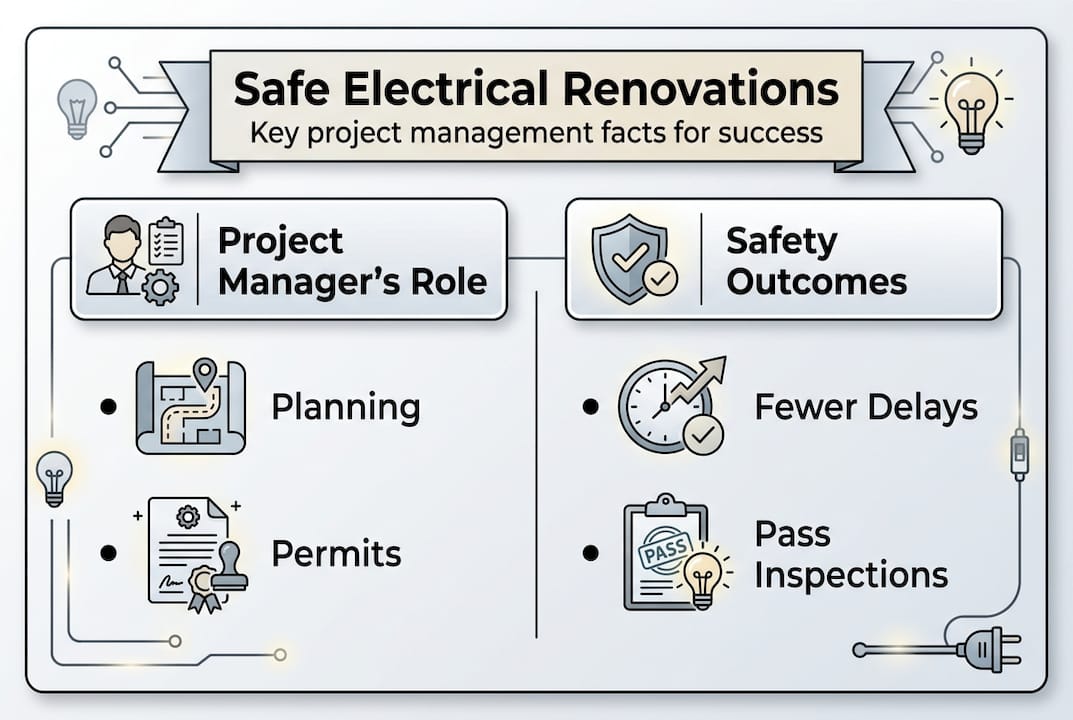
Think of an electrical project manager as the person holding every thread of a project at once. While the crew focuses on the physical work, the project manager is tracking permits, watching the budget, coordinating inspections, and making sure nothing falls through the cracks. It is a role that protects your investment as much as it protects your safety.
Here is what that looks like in practice:
- Planning and estimating: Scoping the full job before a single wire is touched, including labor, materials, and realistic timelines
- Permitting: Pulling the correct permits from your local authority so work is legal and inspectable
- Team coordination: Scheduling electricians, subcontractors, and inspectors so the project flows without costly gaps
- Budget management: Tracking costs against estimates and flagging overruns before they spiral
- Safety oversight: Enforcing job-site safety practices that protect workers and your property
- Code compliance: Ensuring every installation meets current NEC and OSHA requirements
- Inspections: Preparing for and passing all required municipal inspections
“Electrical project managers oversee the full project lifecycle including planning, estimating, permitting, installation coordination, inspections, budgeting, safety, and compliance with NEC 2023 and OSHA standards.”
When you are finding residential electricians for a renovation or addition, you want to know whether they bring this level of management to the job. A contractor who only thinks about the physical installation is leaving you exposed on the legal and safety side. Whether you are planning a kitchen remodel, a panel upgrade, or a pool wiring project, disciplined project management is what separates a smooth job from a costly headache. The services included in electrical projects go well beyond labor hours, and a skilled project manager makes sure every piece is accounted for.
Why expert project management is essential for safety and compliance
Code compliance is not optional. It is the legal baseline that protects your family, your employees, and your insurance coverage. Expert project management is the mechanism that makes compliance happen consistently, not just when someone remembers to check.
Here is how a skilled project manager achieves NEC and OSHA compliance from start to finish:
- Initial scope review: Identify which code sections apply to the specific project type and location
- Permit application: File for all required permits before work begins, including electrical, structural, and specialty permits where needed
- Phased installation planning: Schedule work in stages that allow for inspections at required milestones
- On-site safety protocols: Enforce lockout/tagout procedures, PPE requirements, and clearance rules throughout the job
- Change order review: Evaluate any mid-project changes against code requirements before approving them
- Final inspection prep: Conduct a pre-inspection walkthrough to catch and correct issues before the official visit
What happens when this process is skipped? The consequences are real. Failed inspections halt work entirely, sometimes for weeks. Insurance companies can deny claims on work done without permits. Fines from local authorities can run into thousands of dollars. Most seriously, improperly managed electrical work creates fire and shock hazards that put lives at risk.
PM tools boost efficiency by up to 50% in reporting steps alone, but the bigger win is safety. Prioritizing NEC and OSHA compliance over speed is not just best practice; it is the only responsible approach for any project in an occupied home or business.
Pro Tip: Before signing any contract, ask your contractor directly: “Who manages permitting and code compliance from start to finish?” If they hesitate or redirect the question, that is a warning sign.
Reviewing year-round electrical safety tips and scheduling a professional electrical safety inspection are smart first steps before any major renovation begins.
Cost, scheduling, and coordination: How project managers keep projects on track
Budget overruns and scheduling delays are the two complaints homeowners and business owners mention most after a bad renovation experience. Both are largely preventable with disciplined project management.

The National Electrical Contractors Association (NECA) provides labor productivity benchmarks called man-hour standards that help project managers estimate realistic timelines and labor costs before the job starts. These benchmarks are not guesswork. They are drawn from industry-wide data and give managers a solid foundation for bidding and scheduling. In documented cases, using management software alongside these benchmarks saved 60 foreman hours per week, translating to roughly $260,000 per year in recovered productivity.
Here is how managed and unmanaged projects typically compare:
| Factor | Unmanaged project | Professionally managed project |
|---|---|---|
| Schedule overruns | Common (30%+ delays) | Rare with critical path scheduling |
| Budget overruns | Frequent and unpredictable | Controlled with change order process |
| Inspection pass rate | Lower, multiple revisits | Higher, pre-inspection walkthroughs |
| Reporting time | Manual, time-consuming | Streamlined, up to 80% faster |
| Occupied-space disruption | High, unplanned downtime | Minimized with phased construction |
Phased construction is especially important for occupied homes and businesses. A good project manager plans work in sequences that keep disruption to a minimum, so your family or customers are not left without power at critical times. Change orders, which are adjustments to the original scope, are handled through a formal review process rather than verbal agreements that lead to billing disputes later.
Pro Tip: Ask your project manager how they handle unexpected changes. A clear change order process with written approval protects both sides and keeps the budget honest.
When you invest in reliable electrical service that includes real project management, you are not paying extra. You are avoiding the far larger costs of rework, reinspection fees, and schedule chaos. Reviewing residential project costs upfront with a managed estimate gives you a much clearer picture than a bare-bones quote.
Unique challenges in residential and small commercial projects
Not all electrical projects carry the same complexity. Homes and small businesses face a specific set of challenges that can trip up even experienced contractors without strong project management behind them.
One of the most common decision points is whether a project calls for a partial or full electrical upgrade:
| Factor | Partial upgrade | Full upgrade |
|---|---|---|
| Scope | Specific circuits or panel only | Entire electrical system |
| NEC triggers | Section 110.12 may apply to affected areas | Full NEC review required |
| Cost | Lower upfront | Higher but more comprehensive |
| Risk | Hidden issues may remain | All hazards addressed at once |
| Code inspection | Focused on changed areas | Whole-system inspection |
Beyond the upgrade decision, several other factors create headaches for smaller projects:
- Occupied renovations: Work must be phased carefully to avoid leaving residents or employees without essential circuits
- EV charger and solar additions: Both require load calculations to confirm the existing panel can handle new demand
- Inspection failures: A single failed inspection can halt a project for days or weeks, affecting everyone’s schedule
- Unlicensed work: Hiring unlicensed contractors risks fines, voided homeowner’s insurance, and serious safety hazards
Another factor that surprises many property owners is AHJ discretion. AHJ stands for Authority Having Jurisdiction, which is the local inspector or code official who has final say on what is acceptable in your municipality. Two towns five miles apart can interpret the same NEC section differently. Local expertise matters enormously here. A project manager who works regularly in Delaware and neighboring Maryland knows these local nuances and can navigate them without costly surprises.
NECA benchmarks also help project managers give realistic bids for retrofits and upgrades, which is critical for small projects where budget margins are tight. Rushing schedules with prefabricated components can work, but only when safety and code review are not sacrificed in the process.
For safe electrical repairs and upgrades, the right project manager makes the difference between a smooth job and a regulatory nightmare.
A closer look: What most people miss about electrical project management
After more than 20 years in this business, we have seen a consistent pattern: the most expensive projects are the ones that started with the lowest bid and the least planning. Homeowners and business owners often focus on the hourly rate or the total quote, and skip the harder questions about how the job will actually be managed.
Here is the uncomfortable truth. Rushing a project for speed is almost always a false economy. The days saved by skipping a permit or compressing an inspection schedule are nothing compared to the weeks lost when an inspector shuts the job down. Fixing code violations after the fact costs far more than doing it right the first time.
Real value in electrical project management is invisible when it works. You do not notice the permit that was filed on time, the change order that prevented a billing dispute, or the pre-inspection walkthrough that caught a grounding issue before the official visit. You only notice when those things are missing.
We encourage every homeowner and business owner to ask one simple question before hiring: “Can you walk me through how you managed a project similar to mine?” The answer tells you far more than any price quote. Look for Delaware electrical contractors who can speak confidently about their process, not just their price.
How to ensure expert project management for your next electrical job
Choosing the right electrical contractor means more than finding someone with a license and a truck. It means finding a team that treats project management as a core part of the service, not an afterthought.

At Conductive Electrical Contracting, we bring over 20 years of experience managing residential and small commercial electrical projects across Delaware and neighboring Maryland. Every job we take on includes full permitting, code compliance, scheduling, and safety oversight built in from day one. Whether you need a licensed electrical service for a renovation, a panel upgrade, or a new installation, our team handles the details so you do not have to. Reach out to your local Wilmington electrical contractor or connect with our Dover electrician team to get started with a clear, managed estimate.
Frequently asked questions
What is NEC compliance and why does it matter?
NEC compliance means your electrical work meets the National Electrical Code standards, which NEC 2023 requires for safety and legal protection. Without it, your property faces inspection failures, insurance gaps, and real fire or shock hazards.
Can I manage a small electrical project myself?
You can handle basic planning and coordination, but unlicensed work risks fines, insurance denial, and safety violations that cost far more to fix than hiring a licensed professional from the start.
How does project management affect renovation timelines?
Critical path scheduling and structured PM tools coordinate permits, inspections, and crews so projects finish faster with fewer surprises and costly delays.
What is the difference between partial and full electrical upgrades?
Partial upgrades target specific circuits or panels, while full upgrades address the entire system. Each triggers different NEC requirements and inspection scopes, so the right choice depends on your current system’s condition and your project goals.
Why do some projects fail inspection?
Inspection failures typically happen when work is done without proper permits, code steps are skipped, or unlicensed contractors perform installations that do not meet local standards.