Your electrical panel is the heart of your home or business’s power system, and picking the wrong one can mean fire hazards, failed inspections, or circuits that can’t handle your load. Delaware recently adopted NEC 2020 amendments that expanded AFCI protection to most 15 and 20-amp circuits and tightened GFCI requirements in kitchens and outdoor spaces, meaning older panels may already put you out of compliance. Whether you’re building new, renovating, or simply trying to understand what’s in your utility room, this guide walks you through every panel type, what Delaware codes require, and how to make a decision that keeps your property safe for decades.
Table of Contents
- Key criteria for choosing an electrical panel
- Main types of electrical panels for homes and businesses
- Comparison of panel types: safety, cost, and efficiency
- Choosing the right panel for your Delaware home or business
- The hard truths about panel upgrades in Delaware
- Get expert help with your electrical panel upgrade
- Frequently asked questions
Key Takeaways
| Point | Details |
|---|---|
| Follow Delaware code | Choose panels that comply with NEC 2020 amendments and local safety mandates. |
| Replace hazardous panels | FPE and Zinsco brands pose severe fire risks and require immediate replacement. |
| Plan for future needs | Add 20-50% extra panel capacity to accommodate expansions and upgrades. |
| Permits and inspections matter | All panel upgrades in Delaware need permits and professional inspections for safety. |
| Choose AFCI/GFCI panels | Panels with Arc-Fault and Ground-Fault Circuit Interrupters enhance protection and code compliance. |
Key criteria for choosing an electrical panel
Before you look at brands or price tags, you need to understand what actually determines whether a panel is the right fit. A panel that works perfectly in one home can be a liability in another, and Delaware’s local code requirements narrow the field even further.
Here are the core factors every Delaware homeowner or business owner should evaluate:
- Capacity (amperage): Most older homes run on 100-amp service, but modern households with EV chargers, heat pumps, or home offices often need 200 amps or more.
- Code compliance: Delaware’s NEC 2020 amendments require AFCI (arc fault circuit interrupter) protection on most new 15 and 20-amp branch circuits and GFCI protection in kitchens, bathrooms, garages, and outdoor areas.
- Panel location: Per NEC section 240.24 and 110.26, working clearances are mandatory, meaning the space in front of your panel must be at least 30 inches wide, 36 inches deep, and 6.5 feet high. Panels cannot be placed in bathrooms or clothes closets.
- Brand safety: Federal Pacific Electric (FPE) and Zinsco panels are documented fire hazards. If you have either in your property, replacement is not optional.
- Permits and inspections: Any panel upgrade or replacement in Delaware requires a permit and a follow-up inspection. Skipping this step can void your homeowner’s insurance and create serious liability.
- Future-proofing: Your panel should handle not just today’s load but the load you’ll have in ten to fifteen years.
Considering safer electrical upgrades from the start saves you money and headaches down the road. Upgrading once properly is far cheaper than fixing a botched installation after a failed inspection.
Pro Tip: When sizing your new panel, calculate your current load and then add at least 20 to 30 percent on top. That buffer gives you room for future additions like a workshop, EV charger, or finished basement without triggering another full upgrade.
Now that you understand the importance of selecting the right panel, let’s break down the main types you’ll encounter.
Main types of electrical panels for homes and businesses
Not all panels are built the same, and what works for a small Delaware row home is very different from what a commercial kitchen or manufacturing shop needs. Understanding the key panel types helps you have an informed conversation with your electrician and make a smarter investment.
Fuse boxes
Fuse boxes were standard before circuit breakers became widespread. They use replaceable fuses that melt and break the circuit when overloaded. While fuse boxes are cheaper short-term, they carry a significantly higher fire risk than modern breaker panels. People often install the wrong fuse size to stop nuisance trips, which eliminates the safety protection entirely. Fuse boxes also can’t support AFCI or GFCI breakers, which means they fail Delaware’s current code requirements for new installations.
Single-phase breaker panels
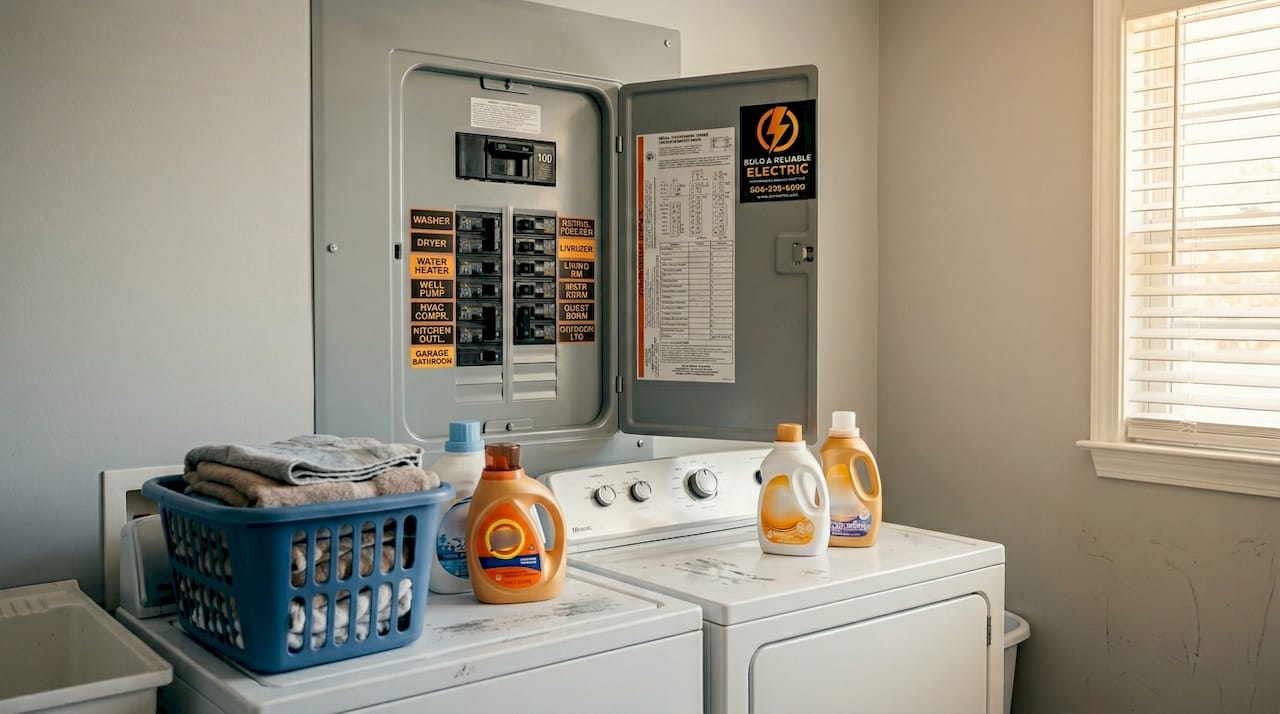
This is the standard for most Delaware homes and small businesses. Single-phase panels use resettable circuit breakers, which are far safer and more convenient than fuses. When a circuit trips, you simply reset the breaker rather than hunt for a replacement fuse. These panels accommodate AFCI and GFCI breakers, making them fully compatible with Delaware’s NEC 2020 requirements. They’re available in a range of capacities, typically 100 to 400 amps, and most residential service panel upgrades land in this category.
Three-phase panels
Three-phase electrical service delivers power more efficiently and is standard in commercial buildings and industrial settings. For small businesses running heavy equipment, multiple HVAC units, or motors over 100 kW, a three-phase system delivers more consistent power with less wasted energy compared to single-phase. It also supports higher total capacity without overloading individual circuits. The trade-off is higher installation cost and the fact that most residential utility connections in Delaware are single-phase only.
Load centers for subpanels
A load center, often called a subpanel, is a secondary distribution point fed from the main panel. These are commonly used in home additions, detached garages, workshops, and commercial tenant spaces. They allow you to add circuits in a remote location without running every wire back to the main panel. Load centers must be properly sized and connected, and they still require permits and inspections in Delaware.
The biggest mistake property owners make is treating panel selection as a pure cost decision. A panel that doesn’t match your load profile or code requirements will cost far more to fix than it saved upfront.
When looking at your options, check our panel brands guide to understand which manufacturers consistently pass inspections and carry strong warranties in the Delaware market.
Pro Tip: Even if you’re buying a home with an existing breaker panel, pull the cover and look at how many open slots are available. A full panel with no room to grow is a hidden problem that can derail renovation plans.
With panel types laid out, comparing their features and risks helps clarify your best option.
Comparison of panel types: safety, cost, and efficiency
Seeing the options side by side makes it much easier to identify what fits your situation. Here’s a straightforward comparison based on safety performance, cost, code compliance, and maintenance demands.
| Panel type | Fire risk | Code compliant | Installation cost | Maintenance |
|---|---|---|---|---|
| Fuse box | High | No (modern standards) | Low | Frequent fuse replacements |
| Single-phase breaker | Low | Yes (with AFCI/GFCI) | Moderate | Minimal |
| Three-phase breaker | Low | Yes | Higher | Minimal |
| Subpanel/load center | Low | Yes (if installed correctly) | Moderate | Minimal |
| FPE/Zinsco legacy panel | Very high | No | N/A (replace immediately) | Not applicable |
A few points worth highlighting from this comparison:
- FPE and Zinsco panels are not just outdated; they are documented fire hazards that have been linked to house fires across the country. Insurance companies are increasingly refusing coverage or raising premiums for homes with these panels still installed.
- Fuse boxes carry higher fire risk partly because they encourage improper repairs. A homeowner who installs a 30-amp fuse in a 15-amp circuit to stop tripping has effectively removed the safety protection from that circuit entirely.
- Three-phase panels cost more upfront but deliver real efficiency gains for businesses running multiple large motors or compressors simultaneously. Over a 10-year period, the energy savings can offset the installation premium.
- Subpanels are excellent for expanding capacity in specific areas, but they must be properly bonded and grounded. Improper subpanel wiring is one of the most common violations found during panel inspections in Delaware.
Scheduling a professional inspection before buying an older property is one of the smartest moves you can make. Use a structured inspection checklist to make sure nothing gets missed, especially in homes built before 1990 where hazardous panels are far more common.
After seeing how panels stack up, let’s apply these lessons to different Delaware scenarios.
Choosing the right panel for your Delaware home or business
Now it’s time to turn the comparison into a practical decision. The right panel for your property depends on your load demands, your building type, your renovation plans, and Delaware’s current code requirements. Here is a step-by-step approach that works for both homeowners and small business owners.
-
Calculate your current electrical load. Add up the amperage draw of your major appliances, HVAC system, water heater, and any heavy equipment. This gives you a baseline number to work from.
-
Project your future load. Are you planning an addition, an EV charger, a hot tub, or new business equipment in the next five to ten years? Build that into your capacity planning now. Experts recommend adding 20 to 50 percent spare capacity above your current calculated load.
-
Identify any hazardous equipment. If your property has an FPE or Zinsco panel, or a fuse box, prioritize replacement before anything else. These are active safety risks, not just inconveniences.
-
Choose the right panel type. Most Delaware homes need a single-phase 200-amp breaker panel with AFCI and GFCI breakers. Most businesses with heavy equipment benefit from three-phase service if loads exceed 100 kW. Smaller commercial spaces often do fine with a robust single-phase setup.
-
Apply for permits before any work starts. Delaware mandates permits and inspections for all panel upgrades. Your licensed electrician should pull the permit on your behalf and coordinate the inspection.
-
Schedule your inspection promptly. Don’t let completed work sit without an inspection for weeks. Delays can complicate your records, especially if you’re planning to sell the property.
Important stat to keep in mind: Homes with 100-amp service and no room for expansion account for a significant portion of failed home sales inspections in Delaware, often derailing deals because buyers can’t get homeowner’s insurance approval on undersized or non-compliant panels.
Pro Tip: Prioritize panels with built-in AFCI and GFCI protection, not just breakers that can be added later. This makes your installation cleaner, your inspection smoother, and your home safer from day one.
Follow the panel upgrade steps that licensed Delaware electricians recommend, and review the residential upgrade guide for a complete picture of what to expect during the process.
With recommendations in hand, let’s share our unique perspective on common mistakes and overlooked strategies.
The hard truths about panel upgrades in Delaware
After more than 20 years working on Delaware properties, we’ve seen patterns that repeat themselves over and over. Most panel upgrade problems are not caused by bad materials or faulty equipment. They’re caused by decisions made before the work even starts.
The number one failure point is undersizing. Owners look at their current usage, add a small buffer, and stop there. But electrical needs rarely shrink over time. Every year, Delaware homes are adding more devices, more appliances, and more high-draw equipment. A 150-amp panel that feels comfortable today can feel strangled within five years if you add an EV charger and a home office circuit.
The second most common problem is ignoring placement rules. The NEC mandates specific clearances around every panel, requiring 30 inches of width, 36 inches of depth, and 6.5 feet of height in front of the unit. We’ve walked into basements where water heaters, storage shelving, or workout equipment was crammed directly in front of the panel. That’s not just a code violation; it’s a dangerous obstacle in an emergency.
The third issue is delay. Many Delaware homeowners know they have an FPE or Zinsco panel and simply put off the replacement because it hasn’t caused visible problems yet. What they don’t realize is that insurance companies are paying attention. Several major carriers have begun refusing to renew policies on homes with these panels, and some buyers’ agents now flag them automatically during transactions. Waiting isn’t neutral; it’s a growing liability.
The fix in all three cases is the same: bring in a licensed electrician early, before you’re under time pressure, and document every step of the process. Photos of the installation, copies of the permit, and a signed inspection result make Delaware panel upgrades smoother at every stage, whether you’re going through inspection or trying to close a real estate deal.
Pro Tip: Always request a copy of your electrical permit and final inspection certificate. Store these with your property documents. They significantly speed up home sales and insurance renewals.
Get expert help with your electrical panel upgrade
Making the right panel choice is straightforward when you have an experienced team walking you through it. At Conductive Electrical Contracting, we’ve handled panel upgrades, safety inspections, and code compliance work across Delaware for over 20 years.
Whether you need a straightforward panel replacement or a full capacity upgrade with new subpanels and AFCI/GFCI compliance, our electrical repair specialists are ready to assess your property and give you a clear, honest recommendation. Our service panel upgrade solutions cover everything from permit applications to final inspection scheduling, so nothing falls through the cracks. New customers can also take advantage of seasonal offers and coupons. Read our Delaware panel safety guide to get started, or contact us directly to schedule your free estimate today.
Frequently asked questions
What electrical panels are banned or unsafe in Delaware?
Federal Pacific Electric (FPE) and Zinsco panels are documented fire hazards and must be replaced immediately in any Delaware home or commercial property.
How much spare capacity should my new panel have?
Experts recommend choosing a panel with 20 to 50 percent spare capacity beyond your current load to accommodate future appliances, additions, or EV chargers without another full upgrade.
Do I need a permit or inspection for changing my electrical panel?
Yes. Delaware requires permits and a licensed inspection for any panel upgrade or replacement, and skipping this step can affect your insurance coverage and property resale value.
Are fuse boxes still allowed in Delaware homes?
Fuse boxes do not meet modern code requirements and cannot support AFCI or GFCI breakers; breaker panels are required for any new installation or full replacement in Delaware.
Can an electrical panel be installed in a bathroom or closet?
No. NEC section 240.24 strictly prohibits panel placement in bathrooms or clothes closets, and Delaware enforces this requirement during all panel inspections.
Recommended
- Electrical Panel Upgrades in Delaware: The Complete Safety Guide
- How to Upgrade Your Electrical Panel: Safer Delaware Homes
- Delaware Electrical Panel Repair: Ensure Safety Now
- 7-step Electrical Panel Board Safety Inspection Checklist
- 24V vs. 12V Permanent LED Lighting: Why Voltage Matters | Starise Lighting Calgary