Plenty of homeowners assume that if you can swap a light switch or reset a breaker, you have what it takes to handle electrical work around the house. That thinking feels logical right up until a circuit catches fire at 2 a.m. or an inspector flags unpermitted wiring that tanks a home sale. Licensed electrical contractors exist for a reason that goes well beyond knowing which wire connects where. This guide walks you through what contractors actually do, how their training works, and how to make smart decisions when your home or business needs electrical upgrades, repairs, or new installations.
Table of Contents
- What does an electrical contractor do?
- Electrical contractor qualifications and training
- Contractors vs. solo electricians: What’s the difference?
- Managing risk and ensuring productivity in electrical projects
- Local nuances: Coastal Delaware challenges and advanced upgrades
- Beyond compliance: What most people miss about electrical contractors
- Find trusted electrical contractors for safe upgrades and repairs
- Frequently asked questions
Key Takeaways
| Point | Details |
|---|---|
| Contractors ensure safety | Licensed electrical contractors follow codes and best practices so your property stays safe and compliant. |
| Training matters | Professional contractors complete years of apprenticeship and continuing education for reliable work. |
| Comprehensive solutions last | Full-service electrical upgrades anticipate future needs, reducing emergencies and improving property value. |
| Local expertise is essential | Delaware homes face unique challenges like corrosion; the right contractor delivers tailored solutions. |
| Plan for productivity | Collaborate using checklists and best practices to avoid overruns and keep your project efficient. |
What does an electrical contractor do?
Now that you know contractors aren’t just handymen, let’s break down their actual responsibilities.
Many people picture an electrician showing up with a tool belt and fixing whatever looks broken. That is part of the picture, but only a small slice. Electrical contractors are licensed professionals responsible for designing, installing, maintaining, repairing, and upgrading electrical systems in residential, commercial, and industrial settings, ensuring safety, efficiency, and compliance with codes like the National Electrical Code (NEC). The NEC is the national standard for safe electrical installation, updated every three years and adopted by most states including Delaware.
Contractors carry legal responsibility for every system they touch. If work fails inspection, causes damage, or leads to injury, the contractor is accountable. That accountability is what separates them from unlicensed helpers or ambitious DIYers.
Here is what a licensed electrical contractor typically handles on any given project:
- System design: Planning circuit layouts, load calculations, and panel sizing before a single wire is pulled
- Installation: Running conduit, wiring outlets, switches, panels, and service entrances
- Diagnostics: Locating faults, tracing shorts, and identifying causes of tripped breakers or flickering lights
- Upgrades: Modernizing outdated panels, replacing aluminum wiring, adding circuits for appliances or EV chargers
- Maintenance: Inspecting systems, testing connections, and catching problems before they escalate
- Code compliance: Pulling permits, coordinating inspections, and ensuring every installation meets NEC and Delaware state requirements
Understanding electrician safety benefits becomes clearer when you realize how many steps go into a single project. A contractor is not just a pair of hands. They are the person keeping your home or business from becoming a fire statistic.
Code compliance is not optional paperwork. It is the difference between a system that runs safely for decades and one that voids your homeowner’s insurance, fails a home inspection, or starts a fire. Every code-compliant repair protects your investment and your family.
Electrical contractor qualifications and training
Understanding the depth of training helps you appreciate what’s behind that license.
Becoming a licensed electrical contractor is not a weekend certification. It is a multi-year process that blends hands-on field experience with formal education and ongoing professional development.
Here is how the path typically unfolds:
- Apprenticeship (4 years / 8,000 hours): Aspiring journeymen complete a rigorous apprenticeship of at least four years and 8,000 hours of supervised field work combined with classroom instruction. This phase covers electrical theory, wiring methods, safety protocols, and code requirements.
- Journeyman license: After completing the apprenticeship and passing a state exam, electricians earn their journeyman license. At this stage they can perform most electrical work under contractor supervision.
- Master electrician and contractor license: Earning a master license requires an additional two to six years of experience beyond the journeyman level, followed by another state exam. The master license is typically required to operate as a licensed contractor and pull permits.
- Continuing education (biennial): Delaware requires licensed contractors to complete continuing education units (CEUs) every two years for license renewal. This keeps professionals current on code updates, new technologies, and safety standards.
That is a minimum of six years before someone can legally operate as an independent electrical contractor, and the learning never stops after that.
What does this mean for your project? It means the contractor walking through your door has logged thousands of hours solving real electrical problems in real buildings. They have studied load calculations, fault diagnosis, and system design. They are not guessing. That project management expertise is exactly what keeps your timeline on track and your budget from spiraling.
Statistic worth knowing: Proper risk assessment and project management avoids cost overruns 60% of the time on electrical projects. Skipping that planning phase is one of the most common ways homeowners end up paying far more than they expected.
Whether you are building new construction or updating new wiring safety in an existing home, the contractor’s depth of training directly affects how smoothly the job goes and how long the results last.

Contractors vs. solo electricians: What’s the difference?
Let’s clarify who you should call, and when, for various electrical needs.
The terms “electrical contractor” and “electrician” are often used interchangeably, but they describe different roles with different scopes of responsibility.
| Feature | Electrical contractor | Solo electrician |
|---|---|---|
| License type | Master/contractor license | Journeyman or apprentice |
| Project scope | Full projects, design to completion | Task-specific, hands-on repairs |
| Team management | Oversees crews and subcontractors | Works independently |
| Permit authority | Can pull permits and manage inspections | Usually works under contractor |
| Accountability | Full legal and financial responsibility | Limited to tasks performed |
| Best for | Rewires, upgrades, new construction | Single repairs, small jobs |
Contractors oversee entire projects and manage teams, while solo electricians typically focus on hands-on work for specific tasks. A comprehensive contractor service anticipates future needs, which significantly reduces the chance of electrical emergencies down the road.
Think about it this way: a solo electrician is like a doctor who treats one symptom. A contractor is more like a physician who reviews your whole medical history, runs diagnostics, and builds a treatment plan. Both have real value, but for complex work, you need the full picture.
When you are dealing with issues covered in our troubleshooting repairs guide or following along with common problems in our homeowners repair guide, a solo electrician can absolutely handle straightforward fixes. But when the job involves upgrading your panel, rewiring multiple rooms, or integrating new technology like EV chargers or solar, a licensed contractor is the right call.
Pro Tip: If you are choosing between a full rewire and patching old wiring, always lean toward the full rewire. Patchwork repairs mask deeper problems, create inconsistent systems, and can actually complicate insurance claims. A full rewire also improves your home’s resale value and makes inspections easier. The residential service benefits of doing it right the first time far outweigh the short-term cost savings of band-aid fixes.
Managing risk and ensuring productivity in electrical projects
Knowing the difference, here’s how professional contractors maximize your project’s value and minimize headaches.
Electrical projects carry inherent risk. Wiring runs through walls you cannot see, circuits interact with equipment you may not understand, and mistakes can be expensive or dangerous. The good news is that structured project management turns unpredictable work into a reliable process.
Research on electrical productivity shows that using checklists and RACI frameworks (which clarify who is Responsible, Accountable, Consulted, and Informed on each task) dramatically improves project outcomes. Early identification of risk, clear cost tracking, and field team involvement all contribute to finishing projects on time and on budget.
Here is a look at typical project timelines and associated risk levels when proper planning is in place:
| Project type | Typical duration | Power downtime | Risk of overrun |
|---|---|---|---|
| Panel upgrade (100-200 amp) | 1 day | 3 to 5 hours | Low with planning |
| Partial rewire (one floor) | 2 to 4 days | Intermittent | Medium |
| Full home rewire | 3 to 7 days | Daily shutdowns | Low with staging |
| EV charger installation | 4 to 8 hours | 1 to 2 hours | Very low |
| Generator hookup | 1 to 2 days | Varies | Low |
Panel upgrades from 100 to 200 amp typically take one full working day, with power off for three to five hours. Knowing this upfront lets you plan around the disruption instead of being caught off guard.
Here are the top things you can do as a homeowner or business owner to get the most from your contractor relationship:
- Share the full picture early. Tell your contractor about every appliance, future addition, or renovation you have planned. Hidden information leads to undersized systems.
- Ask for a written scope and timeline. A professional contractor will provide documentation. If they will not, that is a red flag.
- Confirm permit status before work begins. Permits are not bureaucratic noise. They protect you legally and ensure inspections happen.
- Plan for power downtime. Know which circuits will be affected and when. Good contractors give you a schedule.
- Request a post-project walkthrough. A thorough contractor will show you what was done, what was found, and what to watch going forward.
Whether you are looking at a panel upgrade or broader Delaware home upgrades, bringing your contractor in early and treating the project as a collaboration consistently produces better results than a last-minute, reactive approach.
For anyone new to understanding how your electrical system is organized, a solid overview of electrical panel basics can help you ask the right questions before the work begins.
Local nuances: Coastal Delaware challenges and advanced upgrades
To finish, let’s look at the unique challenges and solutions contractors provide here in Delaware.
Delaware is not a generic electrical environment. Coastal properties near Rehoboth, Lewes, Bethany Beach, and along the Delaware Bay face conditions that directly affect how electrical systems age and perform. Inland industrial zones and chemical industry corridors bring their own set of electrical demands.
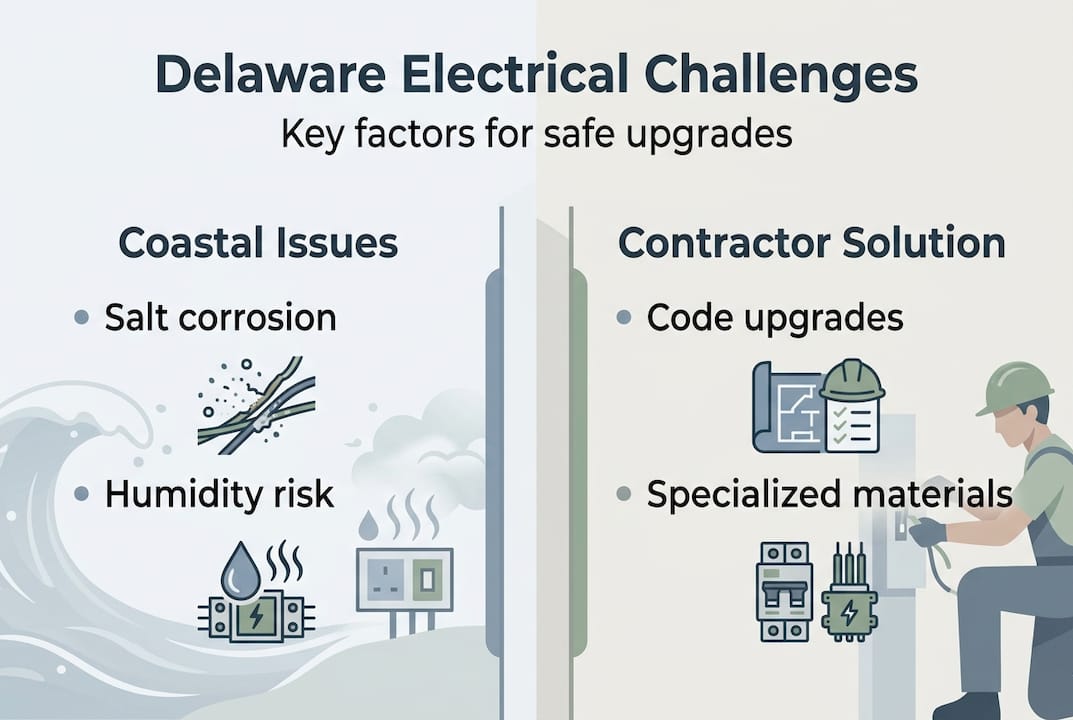
In coastal and chemical areas of Delaware, contractors must address corrosion of wiring connections, junction boxes, and panel components caused by salt air and humidity. Special electrical loads from pumping systems, HVAC equipment, and marine-grade applications require careful load calculations and appropriate materials.
Beyond salt air, here are the extra considerations Delaware contractors navigate regularly:
- Surge protection: Coastal weather patterns mean more lightning exposure and greater risk of power surges damaging electronics and appliances
- Renewable energy integration: Solar panels and battery storage require careful coordination with the existing system and utility grid
- EV charging stations: Adding Level 2 chargers requires dedicated circuits and sometimes a panel upgrade
- Smart panel technology: New smart panels offer real-time energy monitoring and remote shutoff, but installation requires contractor-level planning
- Aluminum wiring replacement: Older Delaware homes often have aluminum branch circuit wiring that poses fire risk and needs replacement with copper
For properties with pools or spa features, pool wiring safety is one of the most code-intensive areas of residential electrical work. The NEC has specific rules about bonding, GFCI protection, and fixture placement near water that only licensed contractors should handle.
Pro Tip: If a contractor recommends replacing a component without running diagnostics first, push back and ask for a full inspection. Thorough diagnosis almost always reveals whether replacement is truly necessary or whether a targeted repair will solve the problem. Replacing parts without understanding the root cause is expensive and rarely fixes the underlying issue.
Beyond compliance: What most people miss about electrical contractors
Most articles about hiring electrical contractors focus on checking the license box and comparing quotes. That is necessary but not sufficient. Here is what over 20 years of field experience actually reveals.
The contractors who deliver the best outcomes are not the ones with the most paperwork. They are the ones who communicate clearly, show up ready to explain what they found, and treat your property with the same care they would give their own. Compliance is the floor, not the ceiling.
A surprisingly common mistake is treating a contractor as a “code checker” rather than a problem-solving partner. When homeowners engage a contractor early in a renovation or upgrade and share their full vision, the contractor can design a system that accommodates future needs. When contractors are called in at the last minute to rubber-stamp decisions already made, the results are often undersized circuits, conflicts with existing systems, and expensive change orders.
The other thing most people underestimate is how much field experience matters compared to credentials alone. A contractor with 20 years of work in Delaware homes has seen patterns that no textbook captures. They know which brands fail in coastal humidity, which panel models develop specific fault patterns, and which upgrades local inspectors scrutinize most carefully.
Smart clients request a diagnostic walkthrough before any major project. They ask for the contractor’s assessment of the full system, not just the one item they called about. Those project management strategies translate directly into safer outcomes and lower long-term costs. The clients who treat contractors as partners rather than vendors consistently get more value from the relationship.
Flexibility matters too. Rigid project management processes can slow down field teams and create bottlenecks. The best contractors balance structured planning with the judgment to adapt when they open a wall and find something unexpected. That combination of process and practical wisdom is what separates good contractors from great ones.
Find trusted electrical contractors for safe upgrades and repairs
Now that you have a clearer view, here’s where to turn for trusted, local expertise.
Conductive Electrical Contracting has served Delaware homeowners and business owners for over 20 years, handling everything from everyday repairs to complex system upgrades with the same commitment to code compliance and customer satisfaction.

Whether you need repair and troubleshooting services for an ongoing issue or are ready to explore panel upgrade solutions to bring your system up to modern capacity, our licensed contractors are ready to assess your situation and give you a clear, honest estimate. We handle surge protection, generator hookups, EV charger installations, pool wiring, and full residential upgrades across Delaware and parts of Maryland. Contact Conductive Electrical Contracting today and get the local expertise your project deserves.
Frequently asked questions
Do electrical contractors need to be licensed in Delaware?
Yes, all electrical contractors must be licensed in Delaware, with journeyman requiring four years and 8,000 hours of apprenticeship and masters needing additional years of experience, plus biennial continuing education for renewal.
How long does a service panel upgrade typically take?
Panel upgrades from 100 to 200 amp typically take one day, with power shut off for three to five hours during the main installation phase.
Why choose a contractor over a solo electrician?
Contractors oversee full projects, manage permits, and anticipate future system needs, reducing emergencies and long-term costs compared to solo electricians who focus on individual task-based repairs.
What extra challenges do coastal Delaware properties face?
Coastal Delaware properties face corrosion from salt air and special electrical loads from HVAC, pumping systems, and outdoor equipment, often requiring modern upgrades, surge protection, and thorough diagnostics from an experienced local contractor.