Most people assume electrical design is something architects and engineers worry about when constructing a brand-new building. The reality is that safe power distribution through deliberate design is just as critical when you’re adding a circuit, upgrading a panel, or installing an EV charger in an existing home or business. Get it wrong, and you’re not just facing inconvenience. You’re inviting overloads, hidden fire risks, and code violations that can complicate insurance claims and home sales for years.
Table of Contents
- What is electrical design and why does it matter?
- NEC load calculations and Delaware code compliance
- Comparing upgrade strategies: load management vs. full service upgrades
- How smart electrical design saves energy and money
- What to expect from a professional electrical design process
- Why shortcuts in electrical design rarely pay off
- Professional electrical design for safer, smarter Delaware homes
- Frequently asked questions
Key Takeaways
| Point | Details |
|---|---|
| Safety starts with design | A well-planned electrical system prevents hazards and meets Delaware’s unique code requirements. |
| Accurate load calculations matter | Correctly sizing your system prevents outages and supports future upgrades like solar or EV charging. |
| Upgrade choices impact efficiency | Strategic design and modern panels can cut bills by 30 to 40 percent over time. |
| Hire verified professionals | Licensed contractors ensure your upgrade is safe, code-compliant, and built for the future. |
What is electrical design and why does it matter?
Electrical design is the planning process that determines how power moves safely through your home or business. It covers everything from circuit layout and wire sizing to load calculations and the placement of safety devices like breakers, GFCI outlets, and AFCI breakers.
Here’s what a proper electrical design addresses:
- Circuit planning: Determining the number, size, and routing of circuits to prevent overloads
- Load calculation: Adding up the total electrical demand of all devices and appliances
- Safety device placement: Deciding where GFCI and AFCI protection is legally required and practically smart
- Code compliance: Ensuring every element meets current standards so inspections pass and liability is minimized
- Future capacity: Building in room for appliances, EV chargers, or solar systems you may add later
“Electrical design ensures safe power distribution, load management, and code compliance for residential installations, repairs, and upgrades.”
This matters enormously in older Delaware homes, many of which were built with 60-amp or 100-amp panels at a time when households used a fraction of today’s electrical load. When you add a central air conditioner, a home office, an EV charger, or a modern kitchen remodel on top of outdated wiring, you create conditions that increase fire risk and reduce system reliability.
Investing in proper Delaware electrical upgrades starts with understanding what your system can safely handle and what it needs to support your life going forward. Without that foundational planning, even well-intentioned improvements can create new problems. The essential electrical upgrades Delaware homes need almost always begin with a licensed electrician assessing the current system against real-world demands.
Pro Tip: Before any significant home improvement project, ask your electrician to assess your current electrical load. It’s a low-cost step that can save thousands in rework later.
NEC load calculations and Delaware code compliance
Load calculation is how licensed electricians figure out how much electrical capacity your home or business genuinely needs. The National Electrical Code (NEC) provides two accepted methods: the standard method and the optional method.
Here’s a simplified breakdown of how a professional calculates your load:
- Calculate general lighting load using 3 VA per square foot of living space
- Add fixed appliance loads such as dishwashers, disposals, and water heaters
- Apply demand factors to reduce the calculated load for circuits unlikely to run simultaneously
- Size continuous loads at 125% to prevent breakers from tripping under sustained use
- Add motor loads, HVAC, and EV charging as separate line items with their own demand considerations
- Total the result and compare it to your current service size to determine if an upgrade is needed
NEC Article 220 load calculations use the standard or optional method, applying VA per square foot for lighting, demand factors, and 125% for continuous loads. Skipping or shortcutting these steps is where serious problems begin. An undersized system doesn’t announce itself with warning lights. It quietly degrades wiring insulation, trips breakers at inconvenient times, and in the worst cases, starts fires inside walls.
Delaware adds another layer of specificity. Delaware adopts the 2020 NEC with amendments that require AFCI protection in dwelling areas, GFCI in wet locations, and frequently trigger panel upgrades when homeowners add modern loads like EV chargers. These aren’t bureaucratic hurdles. They’re guardrails designed around the real failure modes that send people to the hospital.
| NEC requirement | Where it applies | Why it matters |
|---|---|---|
| AFCI breakers | Bedrooms, living areas, hallways | Detects arcing faults before fires start |
| GFCI outlets | Kitchens, baths, garages, outdoors | Cuts power during ground faults near water |
| 125% continuous load rule | All sustained circuits | Prevents overheating of wiring and breakers |
| Demand factor adjustments | Multi-appliance circuits | Reflects realistic simultaneous load |
A licensed electrician uses these requirements as the framework for every panel upgrade decision. The role of electricians in a design-build project goes far beyond just pulling wire. They interpret code, apply local amendments, and engineer a system that will pass inspection and hold up safely under real household conditions.

Proper wiring safety depends on these calculations being done correctly the first time. And when something does go wrong, your Delaware repair guide starts with figuring out what the original design missed.
Comparing upgrade strategies: load management vs. full service upgrades
When a homeowner’s electrical system starts showing strain, there are generally two directions to go. Load management and full service upgrades both solve the capacity problem, but they do it very differently and with very different long-term consequences.
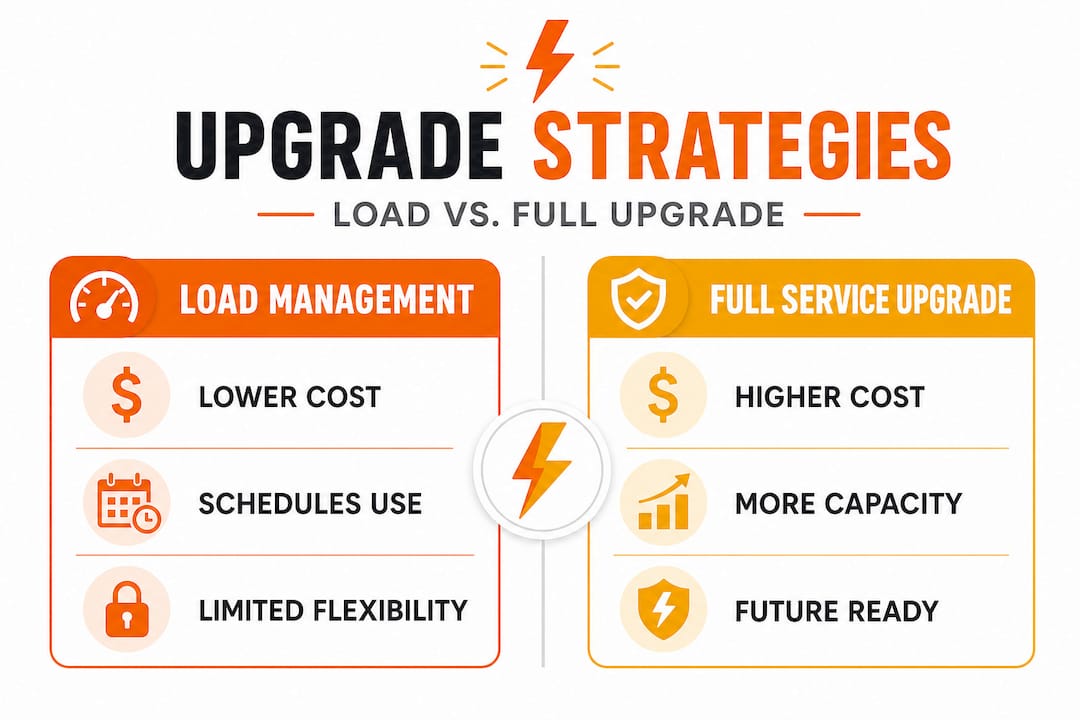
Load management means controlling or scheduling high-draw devices so they don’t run at the same time. A load management system might, for example, prevent your EV charger and electric dryer from running simultaneously, staying within the current panel’s capacity. This approach can delay or eliminate the need for a full upgrade, which makes it attractive on a tight budget.
Full service upgrades replace your main panel and often portions of your wiring to increase total capacity. This typically means moving from a 100-amp service to a 200-amp or 400-amp service, which opens the door to EV charging, solar integration, whole-home generators, and additional circuits without constraint.
Here’s how the two options compare for a typical Delaware homeowner:
| Factor | Load management | Full service upgrade |
|---|---|---|
| Upfront cost | Lower | Higher |
| Long-term flexibility | Limited | High |
| Future EV/solar readiness | Constrained | Fully supported |
| Safety improvement | Moderate | Substantial |
| Code compliance impact | Minimal | Comprehensive |
| Resale value impact | Minimal | Positive |
The NEC optional method is simpler but may underestimate actual demand, and load management defers upgrades while limiting future scalability compared to a full service upgrade. In other words, load management is a bridge, not a destination.
The decision really comes down to your plans. If you’re staying in your home for 10 or more years and you expect to add an EV charger, solar panels, or a heat pump system, a full upgrade almost always wins on total cost of ownership. If you’re preparing to sell soon and just need to address a current capacity issue, managed load distribution might buy you the time you need.
HVAC electrical loads are one of the biggest drivers of capacity problems in Delaware homes. When a new HVAC system gets installed without an updated electrical assessment, it’s a common source of tripped breakers and overheated panels.
Looking at your upgrade options honestly requires factoring in not just today’s needs but what the next decade of technology and lifestyle changes will demand. Getting professional electrical help early in that planning conversation prevents expensive course corrections later.
Pro Tip: If you’re planning to add an EV charger in the next five years, ask your electrician now whether your panel can support a Level 2 charger. It’s far cheaper to plan for it during a current upgrade than to revisit the panel again later.
How smart electrical design saves energy and money
Good electrical design doesn’t just prevent problems. It actively reduces what you spend on power every month and makes your home more comfortable year-round.
The connection between electrical design and energy efficiency is direct and measurable. Case studies show upgrades reduce bills 30 to 40%, with solar and insulation combinations cutting energy use by as much as 42% in some residential applications.
Here are the most impactful design decisions that translate to real savings:
- Right-sized panels: A properly sized panel avoids voltage drop and wasted energy from overloaded circuits
- Dedicated appliance circuits: High-draw appliances like dryers and refrigerators run more efficiently on dedicated circuits with no competition
- LED-optimized lighting circuits: Modern lighting circuits designed for LED loads eliminate compatibility issues and reduce ghost draws
- HVAC circuit design: Properly sized HVAC circuits reduce startup strain and extend equipment life
- Surge protection integration: Whole-home surge protection prevents equipment damage that leads to costly replacement
| Upgrade type | Estimated energy impact | Notes |
|---|---|---|
| Panel upgrade to 200-amp | Indirect but significant | Enables efficient appliance upgrades |
| Dedicated EV charging circuit | Reduces off-peak charging losses | Paired with time-of-use rate planning |
| LED lighting circuit retrofit | 10-15% lighting energy reduction | Eliminates flicker and dimming issues |
| Whole-home surge protection | Extends appliance/electronic life | Prevents replacement cost from surges |
| Solar-ready panel design | Foundation for 30-40% bill reduction | Must be planned into upgrade upfront |
“NEC-compliant design prevents undersizing and unexpected power failures. Homeowners who invest in proper electrical design see measurable, lasting reductions in utility bills.”
Replacing old wiring in older Delaware homes also eliminates resistance-related energy losses that accumulate silently in degraded or aluminum wiring. These aren’t dramatic, sudden failures. They’re slow leaks in your energy budget that compound every month. Pairing wiring upgrades with safe installation services ensures every component works together efficiently, not just safely.
For energy efficient HVAC systems to deliver their rated efficiency, the electrical supply feeding them must be stable, properly sized, and free from voltage irregularities. That’s a design requirement, not just a nice-to-have.
What to expect from a professional electrical design process
If you’ve never gone through a major electrical upgrade with a licensed contractor, knowing what to expect removes a lot of anxiety from the process. A professional design-build approach follows a clear, logical sequence.
- Initial site assessment: The electrician walks your property, identifies your current panel size, documents existing circuits, and notes visible wiring conditions
- Load calculation: All current and planned loads are calculated using NEC Article 220 methods, including any future additions like EV chargers or solar
- Code review: Delaware-specific amendments are applied to determine AFCI/GFCI requirements, panel sizing, and any mandatory upgrades
- Design documentation: A clear layout of circuits, panel configuration, and safety device placement is created before a single wire is pulled
- Permit acquisition: Licensed contractors pull the necessary permits, ensuring inspections are scheduled and all work is on record
- Installation: Work proceeds according to the documented design, minimizing surprises and scope creep
- Commissioning and inspection: The completed system is tested under load conditions to verify performance, and a city or county inspector signs off on compliance
Commissioning verifies performance and ensures that Delaware homeowners and small businesses get NEC-compliant designs with proper load calculations, AFCI/GFCI protection, and systems ready to support EV charging and solar upgrades.
What makes this process valuable isn’t just the technical steps. It’s that a good electrician thinks ahead during every phase. They flag the 60-amp subpanel in your garage that will become a problem when you add a workshop. They notice the double-tapped breakers that a previous owner ignored. They wire for the solar panels you’re planning next year even if you’re only doing a panel upgrade today.
The Delaware installation guide for homeowners considering new installations in 2026 reflects exactly this kind of forward-thinking approach, emphasizing designs that serve current needs without boxing you in.
Pro Tip: Always ask your electrician for a copy of the load calculation worksheet. A professional willingly provides this documentation, and it becomes a useful reference if you expand the system later.
Why shortcuts in electrical design rarely pay off
We’ve worked on enough Delaware homes and commercial properties to say this plainly: the most expensive electrical problems we encounter were almost always caused by someone cutting corners earlier. Not always by homeowners. Sometimes by contractors who pulled electrical work outside their license or expertise.
The argument for shortcuts usually sounds reasonable in the moment. Why upgrade the whole panel if you only need one new circuit? Why bother with a full load calculation if the job seems straightforward? Why hire a licensed electrician when someone charges half the price?
Here’s what those shortcuts actually cost. An undersized panel that seemed fine for three years starts nuisance-tripping when you add an EV charger. The unpermitted work turns into a negotiation nightmare when you try to sell. The homeowner’s insurance company denies a fire claim because the wiring didn’t meet code. These are real outcomes, not scare tactics.
Modern energy demands make this even more pressing. A Delaware home in 2026 routinely expects its electrical system to handle EV charging, whole-home battery backup, solar integration, smart home systems, variable-speed HVAC, and multiple home offices simultaneously. A system designed in the 1980s for a television, a refrigerator, and window air conditioning was never built for this. Only a thorough design process can anticipate these demands without creating new risk.
The importance of skilled electricians goes beyond technical knowledge. It’s about the professional accountability that comes with a license, insurance, and a reputation built on delivering work that lasts. Peace of mind is worth something concrete: knowing your upgrade won’t compromise safety now or when you need to sell, refinance, or remodel in 10 years.
Professional electrical design for safer, smarter Delaware homes
Conductive Electrical Contracting brings over 20 years of licensed experience to Delaware homeowners and small business owners who need more than just a quick fix. Our team handles everything from detailed load assessments to full panel upgrades and new circuit installations, all designed to meet the 2020 NEC and Delaware-specific code requirements.

Whether you need electrical repair experts for an immediate issue or want to plan a full system upgrade, we deliver code-compliant services that are documented, permitted, and built for the long haul. Our service panel upgrades are designed with your current and future load in mind, so you won’t be calling us back in two years to add capacity you should have planned for today. Contact us for a free estimate and get a system that’s safe, efficient, and ready for whatever comes next.
Frequently asked questions
What is the main goal of electrical design in a home or business?
The main goal is to ensure safe power distribution, proper load management, and compliance with codes to prevent hazards and support modern electrical demands reliably.
What’s the difference between load management and a full service upgrade?
Load management controls simultaneous demand to stay within existing capacity, while a full upgrade replaces panels and expands overall service size. Load management defers upgrades but limits future scalability compared to a full service upgrade.
How do panel upgrades help with energy efficiency?
Modern panels enable cleaner, safer circuits that support energy-efficient appliances and reduce waste from overloaded systems. Case studies show upgrades reduce bills by 30 to 40% when paired with other efficiency improvements.
Why is code compliance especially important in Delaware?
Delaware follows the 2020 NEC with amendments that include mandatory AFCI in living areas and GFCI in wet locations, making state-specific compliance a real and enforceable standard, not just a formality.
Should I hire a licensed pro or can I do electrical design myself?
Hiring a licensed pro ensures proper load calculations, code compliance, and a commissioned, tested system that supports future upgrades safely. DIY electrical design in Delaware carries significant legal and safety risks.