Running a commercial property in Delaware comes with responsibilities that go far beyond maintaining a clean parking lot or keeping the HVAC running. Many business owners assume that commercial electrical work is just like what goes on in a house, just bigger. That assumption is costly. Commercial electrical systems operate under stricter code requirements, carry heavier power loads, and demand a level of planning and protective coordination that NFPA 70 standard development makes mandatory for any substantive change. Getting this right protects your staff, keeps your business running, and keeps you on the right side of Delaware’s local inspectors.
Table of Contents
- What is commercial electrical service?
- Key components of a commercial electrical system
- Why compliance and permitting matter for your business
- What to expect from a professional commercial electrical service provider
- The commercial electrical difference: What most people miss
- Choose the right commercial electrical partner for your business
- Frequently asked questions
Key Takeaways
| Point | Details |
|---|---|
| Distinct system complexity | Commercial electrical service involves higher loads and stricter standards than residential. |
| Compliance is essential | Delaware businesses must get permits and inspections to operate legally and safely. |
| Proper planning saves costs | Qualified providers help prevent code issues and business disruptions down the road. |
| Choose expertise | Select a provider with deep knowledge of commercial code and proven Delaware experience. |
What is commercial electrical service?
Most building owners are surprised to learn how differently commercial and residential electrical systems are built and managed. Your home runs on a relatively simple circuit arrangement. Your commercial building is an entirely different challenge, and the stakes for errors are proportionally higher.
Commercial electrical services cover the full range of installation, maintenance, repair, and upgrades inside business properties, from retail shops and medical offices to warehouses and multi-tenant buildings. The core difference is not just scale. It is also complexity, code obligations, and the constant need for operational reliability.
Where a home might have a single 200-amp panel, a commercial building often requires multiple layers of distribution. Power enters the property at the service entrance, flows through main switchgear, then travels via feeder conductors to subpanels, and finally to branch circuits that supply outlets, lighting, and equipment. This power-distribution hierarchy also includes critical grounding, bonding, and protective-device coordination to prevent faults from cascading into fires or major outages.
“The biggest operational risk in a commercial property is not a single failed device. It is a system that was never designed to handle growth, which means every expansion becomes a gamble.”
Here is a quick look at how commercial and residential electrical service compare:
| Feature | Commercial | Residential |
|---|---|---|
| Power loads | High, often 3-phase | Low to moderate, single-phase |
| Code complexity | NEC plus local AHJ requirements | NEC baseline, fewer layers |
| System design | Multi-tier distribution | Single panel to circuits |
| Emergency systems | Required in many building types | Rare, usually optional |
| Inspection frequency | Regular, often required by lease or code | Typically at sale or renovation |
| Operational risk | Business downtime and liability | Personal inconvenience |
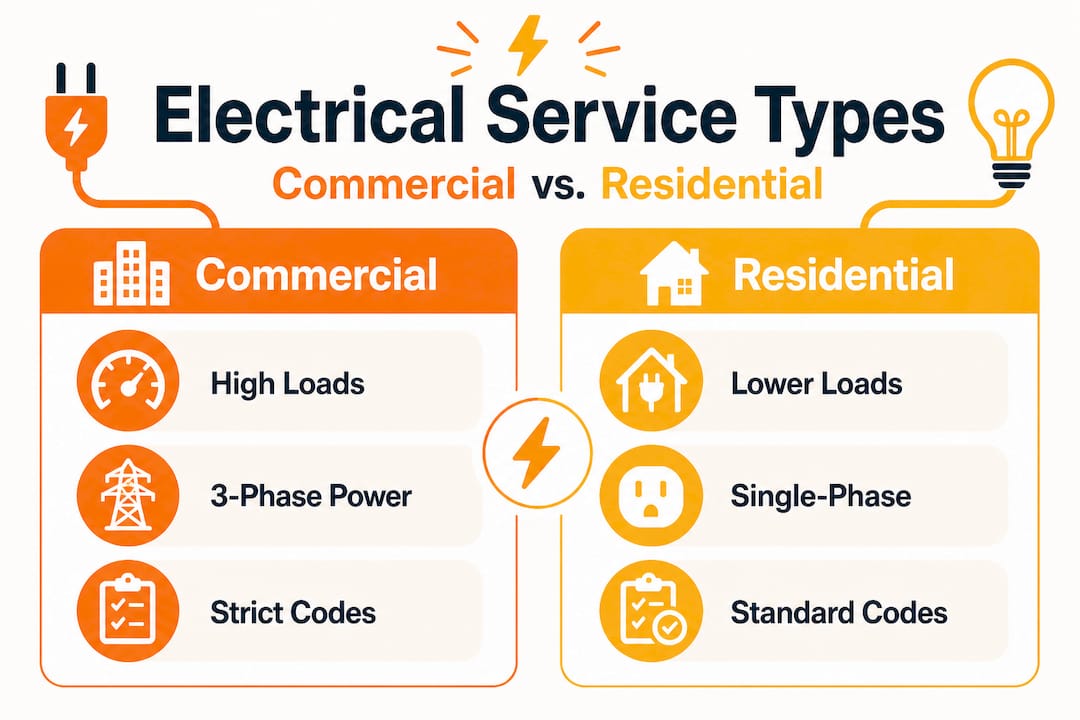
Compare that to residential electrical services, and you can see why treating these two categories as interchangeable is a mistake that shows up in insurance claims and code violations down the road.
Key components of a commercial electrical system
Understanding your building’s electrical anatomy gives you far more than trivia. It gives you a checklist for what to inspect, upgrade, or verify with a licensed contractor. Each component in the system has a specific job, and a failure at any stage puts the entire system at risk.
Here are the major components in a commercial electrical system, listed in the order power flows through your building:
-
Service entrance. This is where power from the utility company arrives at your property. It includes the meter, service conductors, and the main disconnecting means. Proper sizing here determines what your entire facility can handle.
-
Main switchgear or main distribution panel. This equipment receives power from the service entrance and distributes it to multiple feeders. In larger facilities, this is a floor-standing switchgear cabinet with individually rated breakers for each feeder circuit.
-
Feeder conductors. Heavy-duty wiring that carries power from the main switchgear to subpanels distributed throughout the building. These must be sized for total expected load with appropriate safety margins.
-
Subpanels. Located closer to specific zones or floors, subpanels receive power from feeders and break it down further into branch circuits for individual areas of the building.
-
Branch circuits. These are the individual circuits that supply power to specific equipment, outlets, lighting fixtures, and machines. NEC Articles 210 through 230 govern branch circuit and service entrance requirements, while Articles 700 through 702 address emergency and standby power systems.
-
Emergency and backup systems. Many commercial buildings in Delaware are legally required to have emergency lighting, exit signs on dedicated circuits, or full backup generator systems. These protect both people and critical operations during utility outages.
-
Grounding and bonding systems. These are not optional. Proper grounding protects equipment from voltage surges, and proper bonding ensures all metallic components are at the same electrical potential, dramatically reducing shock and fire risk.
Here is a reference table for each component and its primary function:
| Component | Primary function |
|---|---|
| Service entrance | Receives utility power, main disconnect |
| Main switchgear | Distributes power to multiple feeders |
| Feeder conductors | Carries bulk power to subpanels |
| Subpanels | Breaks feeders into branch circuits |
| Branch circuits | Supplies individual loads |
| Emergency systems | Ensures safety and continuity during outages |
| Grounding and bonding | Prevents shock, fire, and equipment damage |
Before any major work begins, following a thorough commercial building electrical checklist helps catch problems before they become code violations or insurance claims. Proper electrical project management during renovations ensures each phase of this system stays intact and code-compliant throughout construction.
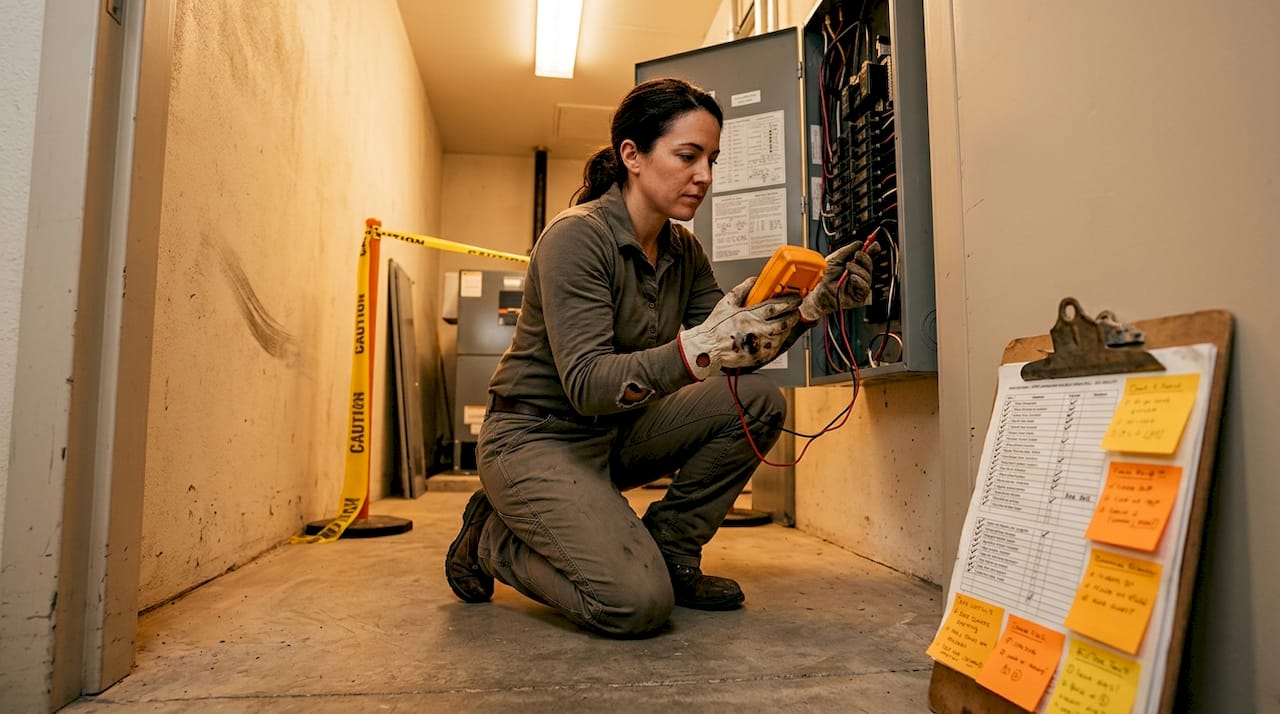
Pro Tip: Load calculations are not estimates. A qualified electrician measures your actual connected loads and applies NEC demand factors to size every component correctly. Undersized systems overheat and fail. Oversized systems waste capital. The math matters.
Why compliance and permitting matter for your business
Here is where many business owners make an expensive mistake. They assume that because the electrical work looks fine, it is fine. Code compliance is not about appearances. It is about documented, inspected, and verified safety.
Delaware businesses must follow the National Electrical Code, which is published under NFPA 70 and enforced by the local Authority Having Jurisdiction. That means any substantive electrical change, whether it is a panel upgrade, new circuits for equipment, or rewiring after a renovation, requires a permit, a licensed contractor, and a formal inspection before the work is considered legal and insurable.
The typical permit and approval process works like this:
- Planning and design. Your contractor evaluates the scope of work, calculates load requirements, and prepares documentation for the permit application.
- Permit application. The contractor submits plans to the local AHJ, which reviews the scope for code compliance before issuing a permit.
- Licensed installation. Work is performed by a licensed electrician in accordance with the approved plans and NEC requirements.
- Rough-in inspection. An inspector from the AHJ visits the site before walls are closed to verify wiring methods, spacing, and device placement.
- Final inspection. After all work is complete and cover plates are installed, the inspector verifies the finished installation and issues a certificate of completion.
“Unpermitted electrical work is not just a fine risk. It is a liability that follows the property. If your building sells, your business has a claim, or your insurance investigates a fire, unpermitted work becomes the center of the conversation.”
Skipping any of these steps is not a shortcut. It is a liability multiplier. An unpermitted panel change that causes a fire can void your commercial property insurance and expose you to lawsuits. Connecting with properly licensed Delaware electrical contractors ensures every step gets documented the right way.
Pro Tip: If you purchase a commercial property and suspect the previous owner skipped permits, request an electrical inspection before anything else. Problems with common electrical repairs are far cheaper to address proactively than reactively after an incident.
What to expect from a professional commercial electrical service provider
Choosing a commercial electrician is not the same as picking the lowest bid. The right contractor becomes part of your facility management team, and the wrong one leaves you with liability you did not ask for.
Here is what a professional commercial electrical service provider should offer:
- Full-scope installation services. New construction wiring, equipment circuits, lighting systems, and service entrance upgrades should all be within their capabilities.
- Emergency repair response. Commercial operations cannot wait. A qualified provider offers responsive service for outages, tripped equipment, or faulted circuits that halt business operations.
- Scheduled maintenance programs. Preventive maintenance catches failing breakers, loose connections, and degraded insulation before they become emergencies. For high-load commercial buildings, this is not optional.
- Code correction work. If a previous contractor left behind non-compliant work, a qualified electrician can identify it and bring the system up to current NEC standards.
- System documentation. Every commercial electrical service engagement should result in updated as-built drawings, panel schedules, and records of work performed. You cannot manage what is not documented.
- Clear, written estimates. Before any work begins, you should receive a scope of work, material list, and pricing in writing. Vague estimates lead to disputes.
Green flags to look for in a proposal include specific NEC article references, listed equipment specifications, and a clear permit and inspection plan. Red flags include verbal-only quotes, no mention of permits, and pressure to start without documentation.
Pro Tip: Ask any contractor how they handle protective-device coordination. This means verifying that breakers and fuses are sized so a fault in one circuit trips only that circuit, not the entire building. A contractor who cannot explain this concept clearly has not done enough commercial work to deserve your trust.
A qualified provider also follows the power-distribution hierarchy as a baseline for every project, ensuring your system is not just working today but designed to stay reliable as your business grows or your loads change.
The commercial electrical difference: What most people miss
After working with commercial properties across Delaware for over 20 years, the pattern we see most often is not a bad panel or outdated wiring. It is a building whose electrical system was never planned as a system at all.
Owners treat electrical service as a commodity purchase. They call when something breaks, pay the minimum to fix it, and move on. What they miss is that every reactive repair is evidence of a system that needed strategic review years earlier. A breaker that keeps tripping is not just an annoyance. It is a signal that load growth has outpaced the original design, and the entire distribution layout may need reassessment.
The business owners who come out ahead are the ones who ask their electrician one extra question: “What does this system need to handle the next five years of our operation?” That question turns a transactional repair into a facility management conversation. It surfaces issues around capacity, redundancy, and code compliance before they surface in an outage or an insurance claim.
Safe electrical project management is not just about keeping the lights on during a renovation. It is about treating your electrical infrastructure as a business asset that requires the same forward-looking attention you give to your lease, your equipment, and your staff.
The most valuable thing a qualified commercial electrician offers is not a repair. It is perspective. They have seen what happens when buildings are pushed past their original design limits, and they know how to create a roadmap that protects your investment rather than just patching it.
Choose the right commercial electrical partner for your business
Understanding how commercial electrical systems work is the first step. Putting that knowledge into action with the right partner is what actually protects your business, your team, and your investment.

Conductive Electrical Contracting brings over 20 years of licensed experience to commercial properties across Delaware. Whether your priority is fast electrical repairs after an unexpected fault, a long-overdue panel upgrade to handle modern loads, or a full system assessment before you sign a new lease, we approach every job with the code knowledge and documentation standards your business deserves. We also make it easy to get started with special deals on electrical services currently available for Delaware commercial clients. Contact us today to schedule a site assessment and get a clear, written estimate from a team that treats your facility like it is their own.
Frequently asked questions
How does commercial electrical service differ from residential?
Commercial electrical service handles larger power loads, more complex systems, and stricter code requirements than residential service. It follows a multi-tier distribution hierarchy including switchgear, feeders, and protective-device coordination that residential wiring simply does not require.
What codes must Delaware commercial electrical service follow?
Work must comply with the National Electrical Code and be inspected by the local Authority Having Jurisdiction. The NEC under NFPA 70 sets the baseline, and Delaware’s AHJ enforces it locally with permits and inspections for all substantive changes.
When do I need a permit for commercial electrical work?
Most significant repairs, installations, or upgrades require a permit and inspection for legal compliance and safety. Under NFPA 70 requirements, skipping the permit process risks voiding insurance and exposing your business to legal liability.
What types of services do commercial electricians provide?
They manage installation, repairs, upgrades, code reviews, emergency systems, and routine maintenance for business properties. A qualified contractor follows the full distribution hierarchy from service entrance to branch circuits, ensuring every component is properly sized, coordinated, and documented.