Faulty wiring, tripped breakers, and outdated panels aren’t just inconvenient — they’re genuine fire hazards that can cost you thousands in damage or void your homeowner’s insurance overnight. Delaware has specific rules about who can perform electrical work, what permits are required, and which safety devices must be installed. Delaware adopted the 2020 NEC effective September 1, 2021, with state amendments enforced by the Delaware Fire Prevention Commission. This guide walks you through everything you need to know to handle electrical repairs safely, legally, and efficiently — whether you’re a homeowner tackling minor fixes or a business owner hiring the right contractor.
Table of Contents
- Understanding Delaware electrical codes and permits
- Choosing the right professional or DIY electrical repair
- Essential tools, safety gear, and prep for electrical repairs
- Step-by-step Delaware electrical repair: Inspection to finish
- Our take: Common pitfalls and best practices in Delaware electrical repairs
- Schedule safe, code-compliant electrical repairs with Conductive Electric
- Frequently asked questions
Key Takeaways
| Point | Details |
|---|---|
| Delaware uses 2020 NEC | All electrical repairs must follow the 2020 National Electrical Code with local amendments in Delaware. |
| Know permit limits | Homeowners can only do limited repairs in their own homes; businesses must use licensed pros. |
| Safety and compliance first | Proper tools, safety precautions, and testing are essential to avoid hazards and code violations. |
| GFCI rule change coming | The HVAC GFCI exemption ends September 1, 2026—prepare to update outdoor units. |
Understanding Delaware electrical codes and permits
Delaware’s electrical code isn’t just a bureaucratic checklist. It’s a system built to protect your family, your property, and your investment. Before you touch a single outlet or breaker, you need to understand the rules that govern electrical work in your state.
The 2020 NEC and Delaware’s amendments
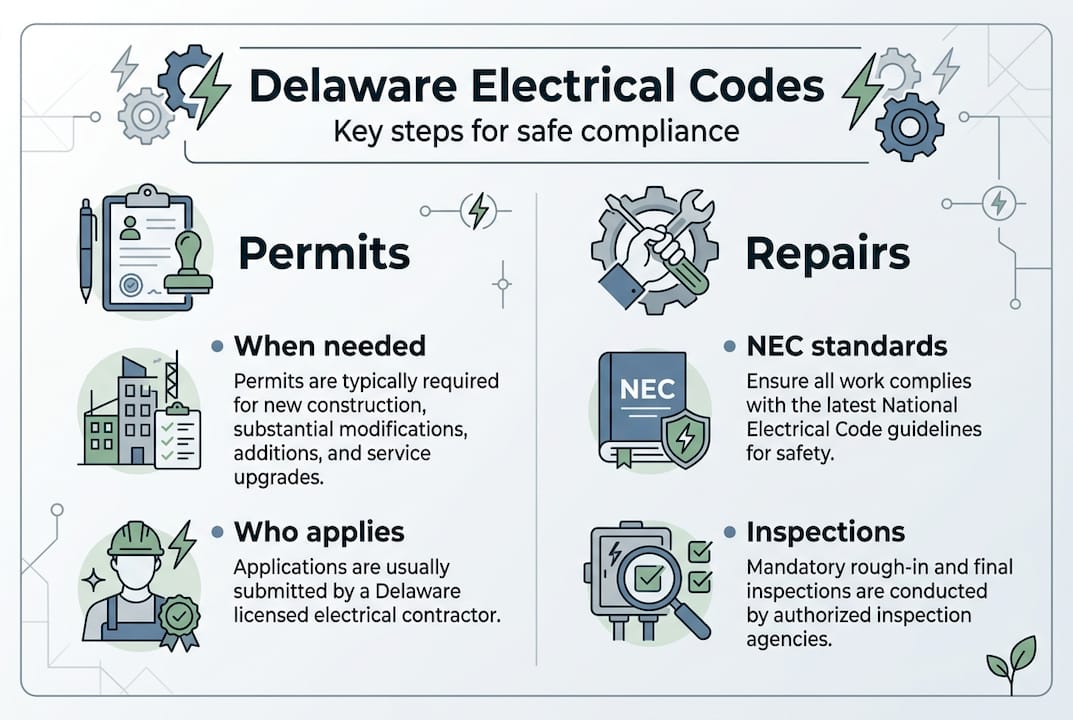
The National Electrical Code (NEC) is a nationally recognized standard that sets minimum requirements for electrical installations. Delaware’s 2020 NEC adoption became effective September 1, 2021, but the state didn’t just copy it word for word. The Delaware Fire Prevention Commission added amendments that reflect local conditions, building types, and safety priorities.
One important thing to understand is that local AHJs (Authorities Having Jurisdiction) can further interpret or modify code requirements. What passes inspection in Wilmington may be reviewed slightly differently in Dover or Smyrna. This is why it’s so important to know your local AHJ before starting any project.
Key code changes that affect your repairs
The 2020 NEC introduced some significant changes that directly impact homeowners and businesses:
- AFCI (Arc Fault Circuit Interrupter) expansion: Required for 120V, 15/20 amp branch circuits in bedrooms, kitchens, living rooms, and other dwelling areas. Arc faults are a leading cause of house fires and AFCI breakers detect dangerous sparking that standard breakers miss.
- GFCI (Ground Fault Circuit Interrupter) requirements: Outdoor outlets must be GFCI protected. This protects against shock from ground faults, which are especially dangerous in wet conditions.
- HVAC exception deadline: GFCI protection for HVAC equipment was granted a temporary exemption, but that window closes September 1, 2026. If your HVAC system isn’t yet GFCI protected, now is the time to plan for it.
For a full breakdown of safety requirements specific to Delaware homes, review this Delaware safety checklist before starting any project.
When do you need a permit?
Most electrical repairs beyond simple fixture swaps require a permit. Here’s a quick breakdown:
| Work type | Permit required? | Who can pull it? |
|---|---|---|
| Replacing a light fixture | Usually no | Homeowner |
| Adding a new circuit | Yes | Master electrician or homeowner (owner-occupied) |
| Panel upgrade | Yes | Master electrician |
| GFCI/AFCI outlet replacement | Varies by AHJ | Homeowner or licensed electrician |
| Commercial wiring | Yes | Master electrician only |
Homeowner permits through DPR are available only for owner-occupied residences and come with strict limits. You cannot pull a homeowner permit for a rental property or any commercial space, period.
Pro Tip: Always call your local AHJ before starting work. A five-minute phone call can save you from a failed inspection, a stop-work order, or a costly tear-out.
Choosing the right professional or DIY electrical repair
Once you’re clear on the code, the next step is deciding who should handle your electrical repairs and what you can legally do yourself. This decision has real legal and financial consequences that go beyond just getting the job done.
Delaware electrician license levels explained
The Delaware Board of Electrical Examiners issues licenses at several levels, each with different privileges:
| License type | Hours required | Key privileges |
|---|---|---|
| Apprentice | Enrolled in program | Supervised work only |
| Journeyman | 8,000 hours | Works independently under master |
| Master electrician | 8,000+ with additional experience | Pulls permits, signs off on all work |
| Residential/Limited | 4,000 hours | Residential work, specific scope |
For any business, a master electrician must serve as the qualifying party on record. You can’t sidestep this by hiring a journeyman-only crew.
What homeowners can legally do themselves
If you own and live in your home, Delaware law allows you to perform some electrical work yourself. Here’s what that looks like in practice:
- Replace a like-for-like outlet or switch in the same location with no wiring changes.
- Swap out a light fixture on an existing circuit without modifying the wiring.
- Reset a tripped breaker or replace a breaker of the same amperage (check your panel first).
- Test and replace a GFCI outlet in the same location.
- Install a ceiling fan where a light fixture already exists with compatible wiring.
Notice what’s missing from that list: adding new circuits, running new wire, upgrading your panel, or doing anything in a rental or business property. Those all require a licensed electrician.
For situations that escalate quickly, like a burning smell, sparking outlet, or sudden power loss, don’t wait. Consult this emergency repair guide for immediate steps you should take before anyone touches anything.
The real cost of unlicensed work
Skipping proper licensing isn’t just a code violation. Your homeowner’s insurance can deny claims if unpermitted work contributed to a fire or injury. Fines for unlicensed electrical work in Delaware can reach hundreds to thousands of dollars per offense. And if you try to sell your home, unpermitted electrical work can kill the deal during inspection.
Before hiring anyone, verify their license through the Delaware Division of Professional Regulation (DPR) website. Ask for their master electrician license number and check it. This electrical safety checklist can help you ask the right questions during the hiring process.
Pro Tip: When comparing quotes from electricians, make sure each bid specifies whether permits and inspections are included. A lower price that excludes permits often ends up costing more in the long run.
Essential tools, safety gear, and prep for electrical repairs
With the legal basics in place, make sure you’re properly prepared before starting any electrical work. The right tools and safety habits can mean the difference between a clean repair and a trip to the emergency room.
Tools every homeowner should have
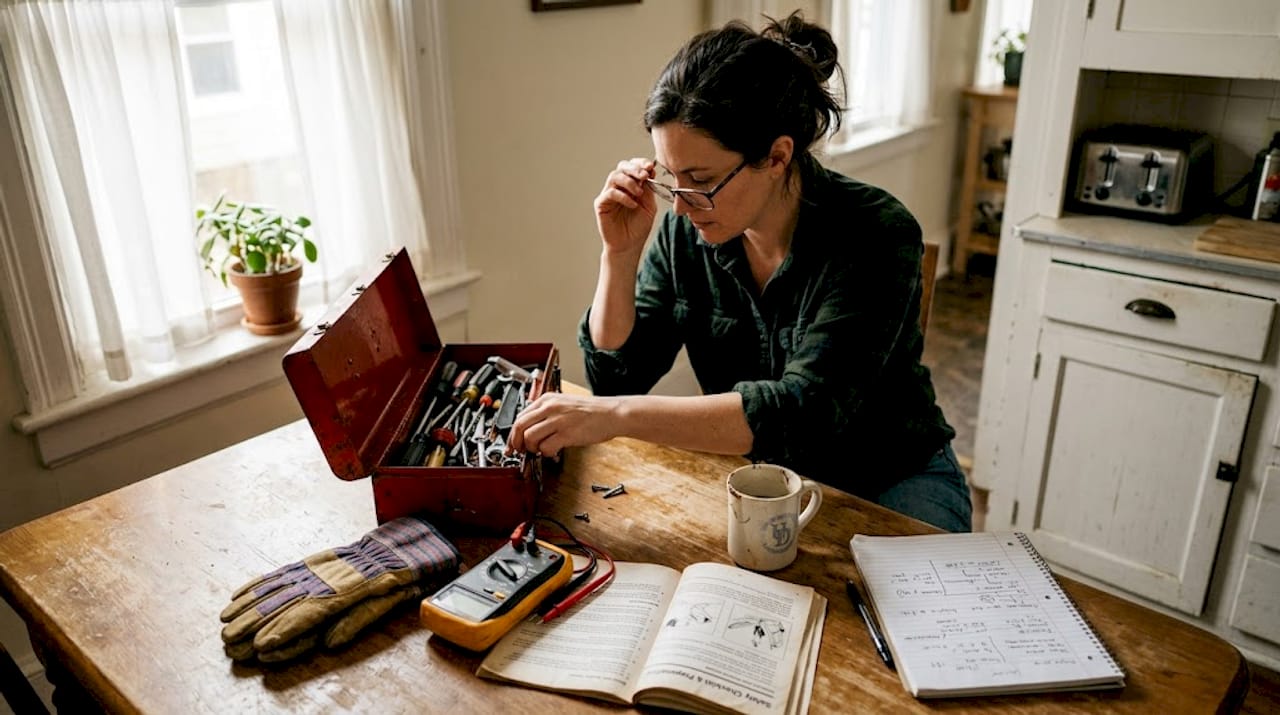
Whether you’re doing basic repairs or just inspecting your system before calling a pro, these are the tools you need:
- Non-contact voltage tester: Tells you if a wire is live without touching it. This is your number one safety tool.
- Digital multimeter: Measures voltage, current, and resistance. Helps you diagnose problems accurately.
- Insulated screwdrivers (flathead and Phillips): Rated for electrical work. Don’t use standard screwdrivers.
- Wire stripper/crimper: For any work involving wiring connections.
- Circuit breaker finder: Lets you identify which breaker controls which circuit without guessing.
- Flashlight or headlamp: You’ll need both hands free when working in panels or junction boxes.
- Electrical tape and wire nuts: Basic connection and insulation supplies.
Personal protective equipment (PPE) for electrical work
Never assume a circuit is dead. Always test with a non-contact voltage tester before touching any wire, terminal, or connection — even after turning off the breaker.
At minimum, wear rubber-soled shoes, safety glasses, and insulated gloves rated for the voltage you’re working with. If you’re near your panel, don’t wear jewelry or loose clothing that could catch on terminals.
Critical pre-repair safety steps
- Turn off the circuit at the breaker panel.
- Test the outlet or fixture with your non-contact voltage tester to confirm it’s dead.
- Lock or tag the breaker if others are in the building (this is called lockout/tagout procedure).
- Remove any standing water near your work area.
- Confirm your tools are rated for electrical use.
Arc faults cause $1.3 billion in US property damage from fires every year. That staggering number is why AFCI breakers exist and why monthly GFCI testing is part of responsible homeownership. Set a monthly reminder to press the test button on every GFCI outlet in your home. If it doesn’t click and reset properly, replace it immediately.
You can find a room-by-room breakdown of what to check in your home using this electrical fire checklist and this broader home safety checklist.
Pro Tip: Keep a flashlight in your electrical panel area at all times. During a power outage, fumbling for light while resetting breakers in the dark adds unnecessary risk.
Step-by-step Delaware electrical repair: Inspection to finish
Now, let’s walk through what a code-compliant Delaware electrical repair actually looks like from start to finish. Whether you’re handling a minor fix or coordinating with a licensed electrician, this process keeps you safe and code-compliant.
Phase 1: Inspection and issue identification
Start by inspecting the affected area before touching anything. Look for:
- Discoloration or scorch marks around outlets or switches
- Flickering lights that may indicate a loose connection or failing breaker
- Outlets that feel warm to the touch
- Breakers that trip repeatedly under normal loads
- Buzzing or humming sounds from outlets or the panel
Document everything with photos. This helps your electrician diagnose faster and creates a record for insurance purposes.
Phase 2: Permit and code confirmation
Before any repair begins, confirm whether a permit is needed. For homeowners in owner-occupied residences, minor repairs may not require one. But anything involving new wiring, circuit additions, or panel work does.
For businesses, AFCI and GFCI requirements under NEC 210.12 and 210.8(F) apply to all new and modified circuits. The 2020 NEC expanded AFCI protection to kitchens, living areas, and virtually all 120V branch circuits in dwelling units — not just bedrooms as in older codes.
Phase 3: The repair itself
Here’s how a standard outlet replacement looks, step by step:
- Turn off the circuit at the breaker.
- Confirm power is off with your voltage tester.
- Remove the outlet cover and unscrew the outlet from the box.
- Photograph the existing wiring before disconnecting anything.
- Connect the new outlet: black wire to brass screw, white wire to silver screw, bare copper to green grounding screw.
- Fold wires carefully back into the box and secure the outlet.
- Replace the cover and restore power at the breaker.
- Test with your voltage tester and confirm the outlet works.
If you’re replacing a standard outlet with a GFCI outlet (which is often required near sinks, in bathrooms, or outdoors), follow the same steps but also connect the load terminals if protecting downstream outlets.
Phase 4: Post-repair verification
| Verification step | Tools needed | Why it matters |
|---|---|---|
| Test GFCI function | Use the test/reset button | Confirms protection is active |
| Test AFCI breaker | Press test button on breaker | Verifies arc fault detection |
| Check panel labeling | Pen and updated circuit map | Required by code; aids future repairs |
| Document repair date | Notebook or digital record | Supports insurance claims and resale |
After any panel-related work, update your panel’s circuit directory. This is actually a code requirement and makes future troubleshooting much faster. Review our home upgrade guide for what to prioritize next after a repair, and use this maintenance checklist to stay ahead of issues before they become emergencies.
Pro Tip: After any electrical repair, plug a simple lamp or phone charger into the affected outlet and leave it running for 30 minutes. If it gets warm, trips, or behaves oddly, you have a deeper issue that needs professional attention.
Our take: Common pitfalls and best practices in Delaware electrical repairs
After more than 20 years of working in Delaware homes and businesses, we’ve seen the same mistakes made over and over again. Most guides give you the textbook answer. Here’s the real-world version.
The biggest hidden risk isn’t bad wiring — it’s ignoring local AHJ variations. Two towns 15 miles apart in Delaware can interpret the same code section differently. We’ve seen projects pass inspection in one county and get red-tagged in another for the exact same installation. Always confirm requirements with your specific AHJ, not just with the NEC text.
For small business owners, one thing is non-negotiable: all commercial work requires master electrician oversight. No exceptions. If someone offers to do your commercial electrical work without a master license, walk away. The liability exposure alone isn’t worth it.
We’re also seeing a significant surge in solar panel and EV charger installations across Delaware. These bring Article 690 (solar photovoltaic systems) and Article 706 (energy storage systems) into play. These are complex code sections that even experienced electricians study carefully. If you’re planning a solar or EV upgrade, make sure your contractor has documented experience with these articles specifically.
Best practice: Test your GFCI and AFCI devices monthly, keep a written log of all repairs and inspections, and schedule a professional walkthrough of your panel every three to five years. Proactive maintenance catches problems that reactive repairs miss entirely. For a full picture of what safe wiring looks like in a Delaware home, see our guide on wiring upgrades explained.
Schedule safe, code-compliant electrical repairs with Conductive Electric
If you want peace of mind and full compliance with Delaware’s codes, here’s how Conductive Electric can help.

At Conductive Electrical Contracting, we’ve been serving Wilmington and the surrounding Delaware area for over 20 years. Our licensed master electricians handle everything from Electrical Repairs & Troubleshooting to full panel upgrades, generator installations, and GFCI/AFCI retrofits. Every job is done to current Delaware code, fully permitted where required, and backed by real experience. If you’re ready for safe, code-compliant electrical repairs or want to plan your next upgrade, contact us for a free estimate. We also offer Residential Electrical Upgrades tailored specifically to Delaware homeowners and small business owners.
Frequently asked questions
Can I do my own electrical repairs in a Delaware rental property?
No. Homeowner permits through Delaware’s DPR are restricted to owner-occupied residences only, which means rental properties and commercial spaces must have all electrical work performed by a licensed electrician.
Does Delaware require GFCI outlets outdoors, and what about HVAC?
Yes, outdoor GFCI protection is required under the 2020 NEC. There is a temporary HVAC equipment exemption that has been in place, but it expires September 1, 2026, meaning HVAC systems will also need GFCI protection after that date.
Who is qualified to pull electrical permits in Delaware?
Only master electricians or homeowners acting on their own owner-occupied residence can pull electrical permits in Delaware. Tenants, business owners, and unlicensed contractors cannot.
Can small business owners do any of their own electrical work?
No. All commercial electrical work in Delaware must be performed or directly supervised by a licensed master electrician, regardless of the scope or simplicity of the task.