If your circuit breaker trips every time you run the dishwasher and the dryer at the same time, your electrical panel is telling you something. Older Delaware homes, particularly those built before 1980, often run on panels that were never designed to handle today’s devices, let alone electric vehicles or heat pumps. Permits and NEC 2020 compliance are required for any panel upgrade in Delaware, and skipping that step creates serious legal and safety risks. This guide walks you through every stage of the upgrade process so you can move forward with confidence.
Table of Contents
- Why upgrade your electrical panel?
- Preparing for your panel upgrade
- Step-by-step: How to upgrade your electrical panel
- Troubleshooting, inspections, and final verification
- A smarter approach to upgrading electrical panels in Delaware
- Upgrade your electrical panel with Delaware experts
- Frequently asked questions
Key Takeaways
| Point | Details |
|---|---|
| Permits and code compliance | All Delaware electrical panel upgrades require permits and adherence to the 2020 NEC with local amendments. |
| Signs you need an upgrade | Breakers tripping, flickering lights, or underpowered panels signal it’s time for an upgrade. |
| Professional vs. DIY | Licensed electricians ensure safe, code-compliant work and proper inspection for your Delaware home. |
| Future-proofing matters | Modern panels support EVs, appliances, and improved home safety while avoiding future costly fixes. |
Why upgrade your electrical panel?
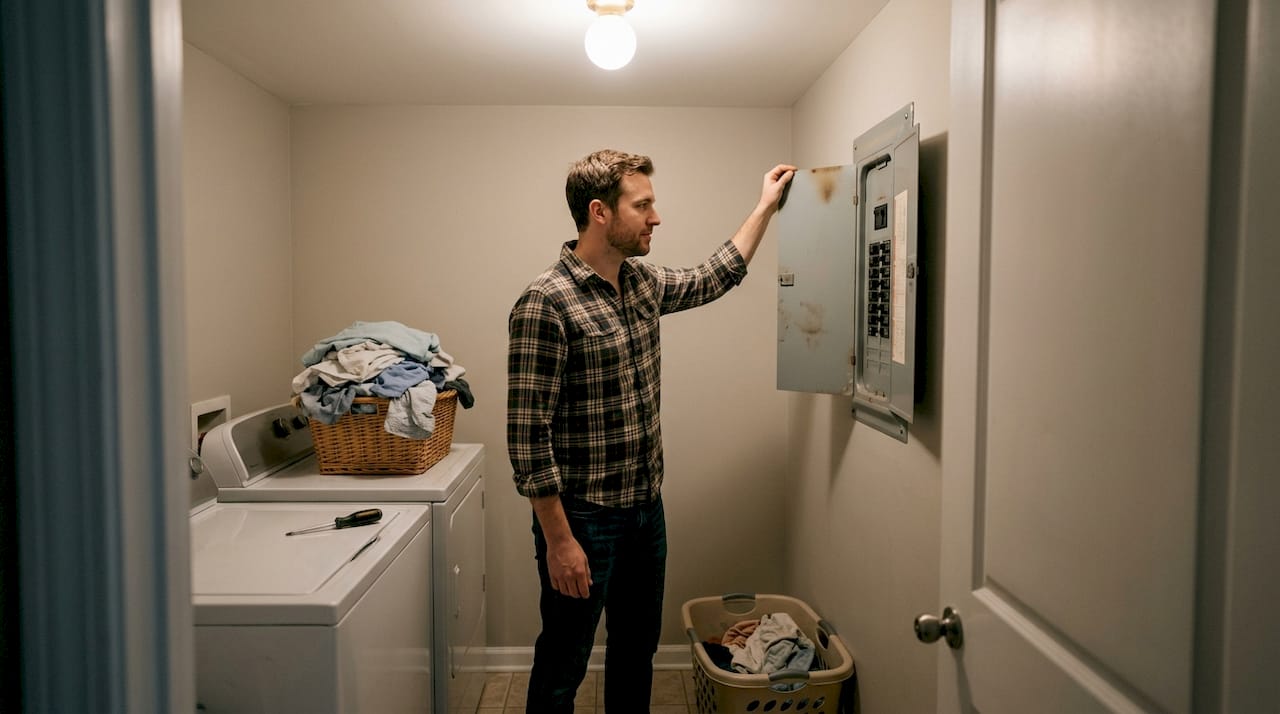
Your electrical panel is the nerve center of your home. Everything from your refrigerator to your home office runs through it. When that panel is outdated or undersized, the risks go well beyond inconvenience.
Older panels simply cannot keep up with modern electrical loads. A 100-amp panel is standard in pre-1980 Delaware homes, but a single EV charger draws roughly 40 amps, and a heat pump can pull anywhere from 15 to 60 amps. Add in a dryer, an air conditioner, and a few smart appliances, and you are pushing the system past its limit every single day.
Here are the most common warning signs that your panel needs attention:
- Breakers trip frequently, even under normal household loads
- Lights flicker when you turn on large appliances
- The panel cover or breakers feel warm to the touch
- You smell burning near the breaker box
- Your panel uses fuses instead of breakers
- You have a Federal Pacific, Zinsco, or other recalled panel brand
Insurance companies are paying attention too. Carriers may require panel replacement if your home has a recalled or known-defective panel, and some insurers will refuse to renew your policy until the upgrade is complete. That alone can make the decision easy.
A note on future-proofing: Upgrading to a 200-amp or 400-amp panel today is not just about solving today’s problems. It positions your home for EV charging stations, solar battery storage, and high-efficiency HVAC systems without forcing another costly upgrade in five years.
Beyond the practicalities, there is a real safety case here. Overloaded panels generate heat, and heat inside electrical panels can ignite surrounding materials. Reviewing the Delaware electrical panel upgrade guide can help you understand exactly what your home’s system is up against and what a modern, code-compliant panel looks like.
With the importance clear, let’s look at how to get ready for an upgrade.
Preparing for your panel upgrade
Now that you understand what’s at stake, it’s time to get prepared. Preparation is where most homeowners either get it right or create expensive problems for themselves down the road.
The first thing to confirm is your permit and code requirements. Permits are required in every Delaware county, and all work must meet the 2020 National Electrical Code with Delaware-specific amendments. That includes requirements for arc fault circuit interrupters (AFCIs) in bedrooms and living areas, and ground fault circuit interrupters (GFCIs) in kitchens, bathrooms, garages, and outdoor spaces. Skipping permits is not just risky; it can void your homeowner’s insurance and complicate a future home sale.
Next, calculate your home’s expected electrical load. Think about what you have now and what you plan to add over the next decade.
Here is a quick reference table for common load requirements:
| Appliance or System | Typical Amperage Draw |
|---|---|
| EV charger (Level 2) | 32 to 50 amps |
| Central air conditioning | 15 to 60 amps |
| Electric dryer | 30 amps |
| Heat pump | 15 to 60 amps |
| Electric range | 40 to 50 amps |
| Hot tub or pool pump | 20 to 50 amps |
Once you know your load, you can determine whether a 200-amp upgrade is sufficient or whether a 400-amp service makes more sense for your household.
Here are the key preparation steps in order:
- Research your county’s permit office and application process
- Review Delaware’s panel repair and code rules for any local amendments
- Calculate your current and projected electrical load
- Schedule a panel safety inspection to assess your existing equipment
- Get written estimates from at least two licensed Delaware electricians
- Confirm your utility provider’s process for service disconnection and reconnection
Pro Tip: Hire a licensed electrician before you purchase any equipment. Panel sizing, breaker compatibility, and service entrance requirements vary by home age and utility provider. Getting professional eyes on your setup early prevents costly missteps.
Step-by-step: How to upgrade your electrical panel
Now you’re ready for the main event, the actual upgrade process. This is not a DIY project. Delaware law requires that licensed electricians handle permit applications, inspections, and any work involving the service entrance.
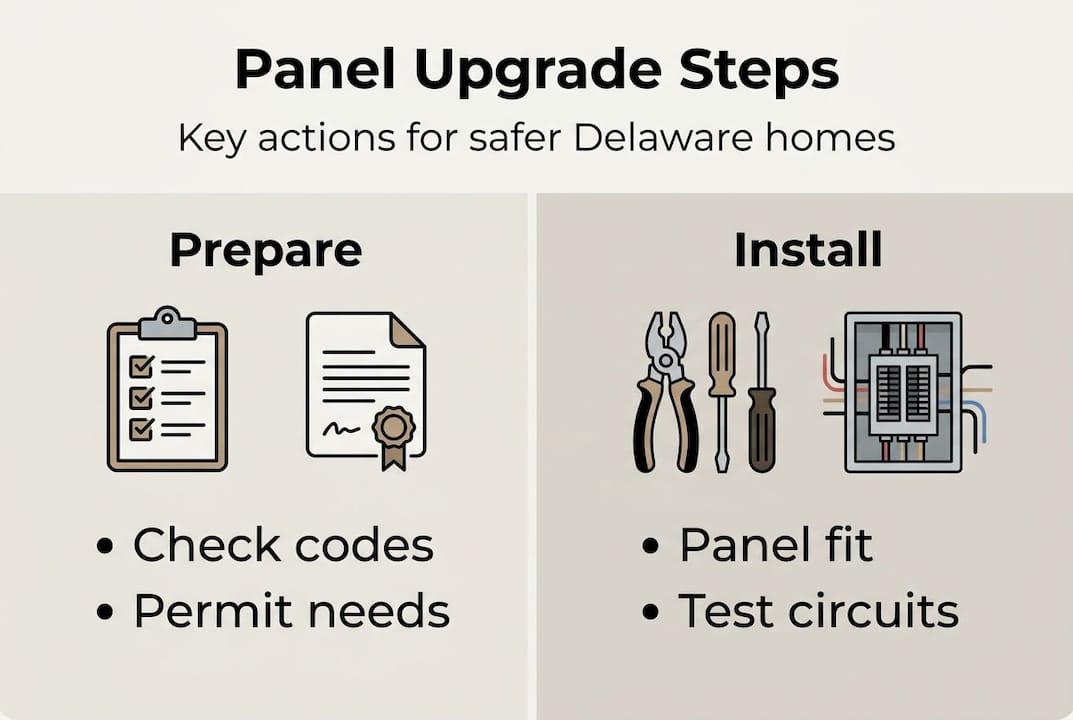
Here is how a proper panel upgrade unfolds from start to finish:
- Contact your utility company to schedule a service disconnect. This is mandatory before any work begins on the main panel.
- Pull the required permits through your county. Your electrician typically handles this, and electricians manage permits and coordinate with inspectors as part of the job.
- Remove the old panel after confirming power is off at the meter. The electrician will document existing circuit assignments before disconnecting.
- Inspect the service entrance and meter base. In older Delaware homes, service entrance upgrades are often needed alongside the panel itself, particularly in homes built before 1970.
- Install the new panel, mount the breakers, and reconnect all circuits according to the load schedule.
- Install required AFCIs and GFCIs in the appropriate circuits per NEC 2020.
- Request the county inspection before closing the panel cover.
- Schedule utility reconnection once the inspector signs off.
Here is a quick comparison to help you decide between an upgrade and a full replacement:
| Scenario | Best Option |
|---|---|
| Panel is structurally sound, needs more circuits | Upgrade (add subpanel or breakers) |
| Panel is corroded, recalled, or fire-damaged | Full replacement |
| Home pre-dates 1980 with original service | Full replacement with service upgrade |
| Adding EV charger or solar to existing 200A | Upgrade or subpanel |
For a detailed breakdown of each phase, the service panel upgrade steps and panel replacement guide are solid references to review with your electrician.
Pro Tip: Never let a contractor install tandem breakers as a shortcut to squeeze more circuits into an existing panel. They overload the busbar, violate NEC code, and create a real fire hazard. If you need more circuits, the right answer is a larger panel or a subpanel.
Troubleshooting, inspections, and final verification
With everything in place, focus shifts to final checks and future safety. Passing the county inspection is the milestone that confirms your upgrade was done correctly, but there are several common issues that can delay that approval if you are not prepared.
The most frequent inspection failures include:
- Missing AFCI breakers in required locations
- Improper grounding or bonding at the new panel
- Circuits not labeled clearly in the directory
- Open knockouts on the panel enclosure
- Wiring entering the panel without proper connectors or clamps
Your electrician should perform a pre-inspection walkthrough to catch these before the county inspector arrives. Once you pass, you receive a certificate of occupancy or inspection approval that documents the work for your records and your insurer.
Long-term panel health matters. Delaware’s coastal humidity creates conditions where moisture can seep into panel enclosures and cause corrosion on bus bars and breaker contacts over time. Even a new panel needs periodic attention.
Here are the habits that keep your panel safe and compliant for years:
- Schedule a visual inspection every three to five years with a licensed electrician
- Never store items in front of the panel (NEC requires 36 inches of clear working space)
- Check for moisture, rust, or unusual odors after heavy storms
- Test GFCI outlets and AFCI breakers monthly using the test button
- Keep your circuit directory updated when you add new circuits or appliances
- Use the panel inspection checklist and panel safety tips as ongoing references
The NEC and Delaware code compliance process does not end at installation. Keeping your documentation, maintaining your panel, and calling a licensed electrician when something seems off is what separates a safe home from a liability.
A smarter approach to upgrading electrical panels in Delaware
Here is what most homeowners and even some contractors get wrong: they treat an electrical panel upgrade as a minimum-compliance exercise. They size the new panel to meet today’s needs and nothing more. That thinking is expensive.
We have seen it repeatedly over more than 20 years serving Delaware homeowners. A family upgrades to a 150-amp panel in 2022, installs a heat pump in 2024, and then wants an EV charger in 2026. Suddenly they need another upgrade, another permit, another utility disconnect, and another inspection fee. Doubling that cost was completely avoidable.
The smarter move is to look at future-proofing with modern upgrades and size your panel for what your home will need in ten to fifteen years, not just what it needs today. A 200-amp service is the minimum standard in most modern builds. For larger homes or properties planning solar, battery storage, or multiple EV chargers, 400-amp service is worth the conversation.
Tandem breaker shortcuts are another thing we see more than we should. They are a band-aid that creates code violations and real fire risk, and they always end up costing more to undo than to avoid in the first place. Size the panel correctly from the start and you will not be tempted by that shortcut.
Proactive upgrades also affect your insurance premiums and coverage options. Delaware insurers look favorably on updated panels, and in some cases the savings on your annual premium can meaningfully offset the cost of the upgrade over time.
Upgrade your electrical panel with Delaware experts
If reading this guide made you realize your panel is overdue for attention, you do not have to figure out the next steps alone.
At Conductive Electrical Contracting, we have handled expert panel upgrade solutions for homeowners across all Delaware counties for more than 20 years. We pull permits, coordinate with your utility, handle inspections, and make sure your system meets every NEC 2020 requirement. Whether you need electrical repairs and troubleshooting on an existing panel or a full service upgrade, we offer honest estimates and current specials to keep the project affordable. Explore our full range of Delaware home electrical upgrades and contact us today to schedule your assessment.
Frequently asked questions
Do I need a permit to upgrade my electrical panel in Delaware?
Yes, permits are required in all Delaware counties, and all work must comply with the 2020 National Electrical Code along with Delaware-specific local amendments.
How do I know if my panel needs upgrading?
Frequent breaker trips, flickering lights, or a 100-amp panel in a pre-1980 home are strong indicators that your system cannot meet modern electrical demands.
What are the special considerations for upgrading panels in older Delaware homes?
Homes with knob-and-tube or aluminum wiring may need rewiring or GFCI retrofitting to meet NEC 406.4 code requirements before a panel upgrade is approved.
Can I use tandem breakers as a quick fix for extra circuits?
Tandem breakers overload the busbar and violate NEC code, making them a code violation and a fire risk rather than a genuine fix.
Is it better to upgrade or replace the electrical panel?
Upgrade if the panel is structurally sound and just needs more capacity; opt for a full replacement if corroded or recalled, or if the service entrance is undersized for modern loads.