That power strip under your desk probably isn’t protecting anything. Most Delaware homeowners and small business owners assume any multi-outlet strip counts as surge protection, but that’s a costly mistake. One power surge can destroy thousands of dollars in electronics, appliances, and business equipment in a fraction of a second. This guide breaks down what surge protection really is, how it works, which devices actually keep your property safe, and what steps Delaware homeowners and business owners should take right now to stay protected.
Table of Contents
- Understanding the risks: Power surges and their impact
- What is surge protection and how does it work?
- Types of surge protection devices: Which do you need?
- Choosing and maintaining surge protection for Delaware homes and businesses
- Why real surge protection is non-negotiable in Delaware
- Protect your property with expert surge protection solutions
- Frequently asked questions
Key Takeaways
| Point | Details |
|---|---|
| Surge protection is crucial | Effective surge protection prevents expensive damage and extends the life of your electronics. |
| Layered defense works best | Combining whole-house and plug-in protectors offers the most reliable safety for Delaware homes and businesses. |
| Regular maintenance matters | Surge protectors must be replaced every few years and after major power events to remain effective. |
| Certified solutions are safer | Choose UL- or IEEE-certified surge protection devices installed by professionals for maximum peace of mind. |
Understanding the risks: Power surges and their impact
A power surge is a sudden, brief spike in electrical voltage that exceeds the normal flow running through your wiring. Standard household current in the U.S. runs at 120 volts. Surges can spike that to thousands of volts in milliseconds, and your electronics have no natural defense against it.
Common causes include lightning strikes near your property, your electric utility switching loads on the grid, large appliances like air conditioners or refrigerators cycling on and off, and faulty wiring inside your home or business. Each of these can push excess voltage through your circuits without any warning.
The damage adds up fast. Home office computers lose unsaved work and corrupted hard drives. Smart TVs, gaming systems, and connected appliances get fried. For a small business, a surge hitting a point-of-sale system or server can mean hours of downtime and real revenue loss. IEEE estimates surges cause billions in property damage annually across the country.
Devices most vulnerable to power surges:
- Flat-screen TVs and home theater systems
- Desktop and laptop computers
- HVAC systems and smart thermostats
- Business point-of-sale terminals
- Refrigerators and washing machines with digital controls
- Medical devices and home security systems
Understanding electronic damage risks from voltage spikes is the first step toward protecting what you own. Pay attention to electrical safety hazards inside your property too, since internal wiring faults are a surprisingly common surge source.
Most people think a power strip is a surge protector. It isn’t. A basic strip just splits one outlet into several. Without a rated surge protection component inside, it offers zero protection against voltage spikes.
Knowing what you’re actually up against makes the solution much clearer.
What is surge protection and how does it work?
Surge protection is exactly what it sounds like: a system or device designed to shield your electronics from sudden voltage spikes by diverting excess energy before it reaches your equipment. True surge protectors contain internal components that actively monitor and respond to voltage levels.
The key component inside most surge protectors is called a Metal Oxide Varistor, or MOV. Think of an MOV as a pressure relief valve for electricity. When voltage rises above a safe threshold, the MOV absorbs the excess and redirects it to the ground wire, keeping your devices safe. When voltage is normal, the MOV stays out of the way entirely.
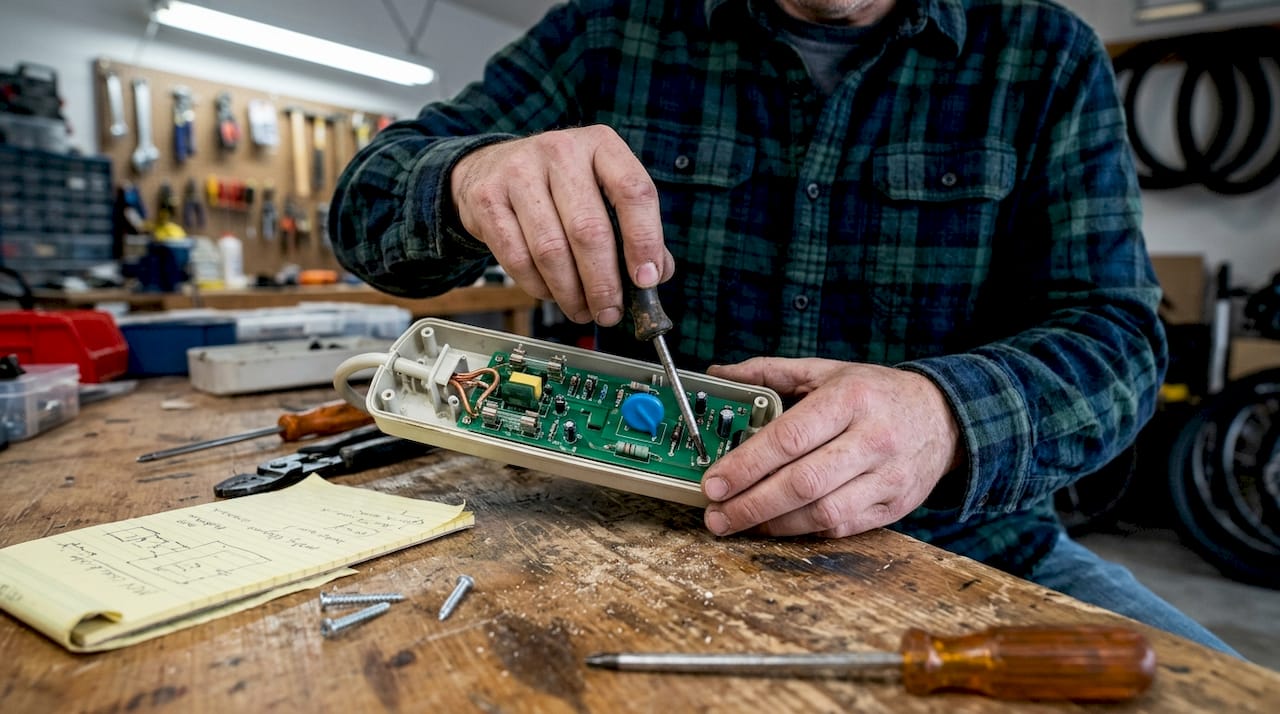
Here’s the catch: MOVs wear out. Every time they absorb a surge, they degrade slightly. After enough events, or one very large one, they stop working. Yet the device may still power your equipment normally, giving you false confidence. MOVs degrade over time and need replacement even if the unit appears to function.
How a surge protector works, step by step:
- Voltage rises above normal (120V) during a surge event
- The MOV detects the spike and activates
- Excess energy is diverted through the ground wire
- Voltage reaching your device stays within safe limits
- The MOV absorbs damage so your equipment doesn’t
Proper grounding is non-negotiable here. Without a correctly grounded outlet, the MOV has nowhere to send that excess energy, and protection fails completely. Also, never daisy-chain power strips together. This is a common and dangerous practice that overloads circuits and bypasses any safety ratings the individual strips carry. Learn more about whole house surge protection options if you want real coverage beyond a single outlet.
| Feature | Basic power strip | Surge protector |
|---|---|---|
| Splits outlets | Yes | Yes |
| Blocks voltage spikes | No | Yes |
| Contains MOVs | No | Yes |
| Joule rating listed | No | Yes |
| Needs replacement | No schedule | Every 3-5 years |
Pro Tip: Check your surge protector for an indicator light that confirms MOV functionality. If the light is out, the device is no longer protecting anything even if it still powers your gear. Replace it immediately.
Understanding power surge protection basics helps you make smarter purchasing decisions for every room in your home or business.
Types of surge protection devices: Which do you need?
Not all surge protection devices are equal, and picking the wrong type means gaps in your coverage. SPDs are classified into Type 1, 2, and 3, each designed for a specific point in your electrical system.
Type 1 devices install at the service entrance, which is where power from the utility line enters your building. These handle large external surges, especially from nearby lightning strikes. They require professional installation and are the first line of defense.
Type 2 devices mount at your main electrical panel. They protect against surges coming from the grid and from large appliances inside your property. These are the workhorses of a whole-home or whole-business surge protection system.
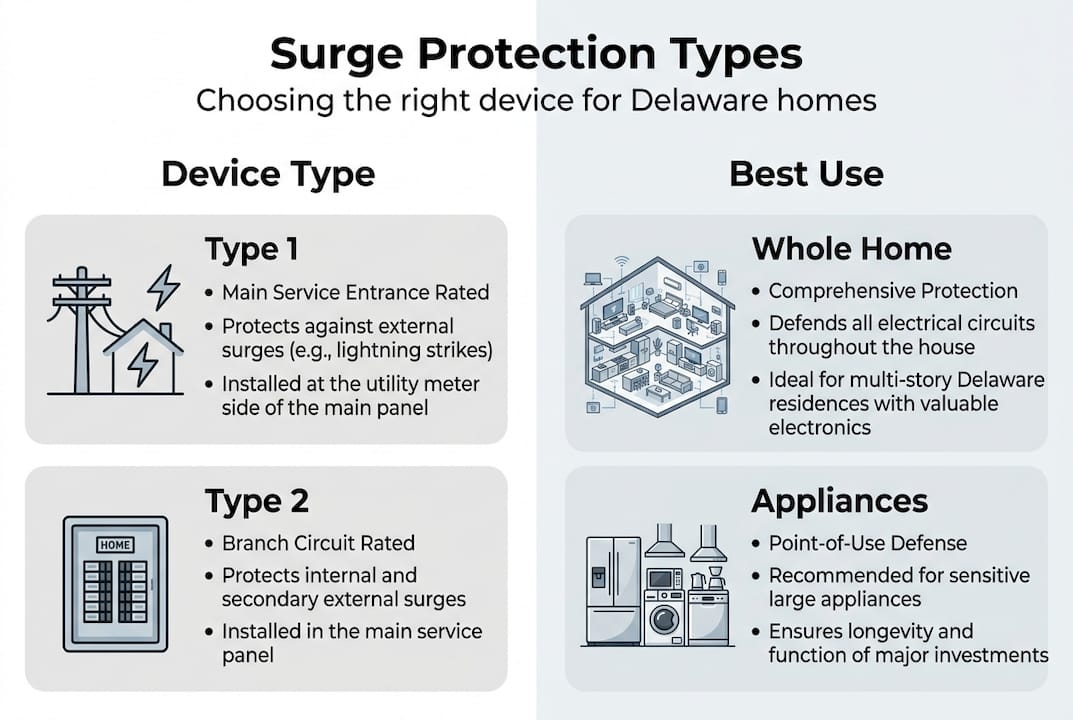
Type 3 devices are the plug-in units and power strips with surge ratings you find at hardware stores. They provide device-level protection and work best as a second layer after Types 1 and 2 are in place.
| SPD Type | Installation location | Protection level | Best for |
|---|---|---|---|
| Type 1 | Service entrance | Highest (lightning) | Homes in storm-prone areas |
| Type 2 | Main electrical panel | High (grid surges) | Most Delaware homes and businesses |
| Type 3 | Individual outlets | Moderate (device-level) | Sensitive electronics, offices |
When shopping for any SPD, look for a UL 1449 certification label. This is the key standard that verifies a device actually provides rated surge protection. Unrated products sold as surge protectors flood retail shelves, and many offer little real protection. More detail on SPD standards overview helps clarify which certifications matter most.
For Delaware homes and businesses with modern HVAC systems, smart appliances, or office equipment, a multi-stage approach combining Type 2 at the panel with Type 3 at key outlets gives you the most effective protection. Review the Delaware surge protection variations to find the right fit for your property.
Pro Tip: Think of surge protection like layers of clothing in cold weather. One thin layer isn’t enough. A Type 2 panel device plus Type 3 plug-in units together block far more than either can alone.
Choosing and maintaining surge protection for Delaware homes and businesses
Delaware’s weather brings real risks. Coastal storms, summer lightning, and grid-switching events from heavy AC demand all create surge exposure that’s hard to ignore. Choosing the right protection starts with honestly assessing your property and what’s at stake.
Steps to choose the right surge protection:
- Identify your highest-risk equipment (computers, HVAC, medical devices, POS systems)
- Check whether your outlets are properly grounded before installing any SPD
- Choose a Type 2 panel-level device for baseline whole-property coverage
- Add Type 3 plug-in protectors for high-value electronics
- Confirm UL 1449, IEC 61643, or IEEE C62.72 certification before purchasing
For panel-level devices, always call a licensed electrician. These units involve direct work on your electrical panel, and incorrect installation can void your homeowner’s insurance and create new safety hazards. A professional can also spot whether your current panel setup meets local code requirements, which matters for UL and code compliance in Delaware.
Maintenance checklist:
- Inspect indicator lights on plug-in SPDs monthly
- Replace plug-in units every 3-5 years regardless of visible condition
- Schedule a panel-level SPD inspection after any major storm
- Watch for electrical repairs needs like frequently tripping breakers, which may signal wiring issues that worsen surge risk
Following a solid power surge maintenance guide ensures your protection doesn’t quietly expire while you think you’re covered.
Pro Tip: Keep a photo of your surge protector’s purchase receipt on your phone. When replacing it, you’ll know exactly how old the unit was and can show documentation for insurance claims if needed.
Why real surge protection is non-negotiable in Delaware
After more than 20 years of electrical work in Wilmington and across Delaware, we’ve seen the aftermath of underestimating surges firsthand. A single summer storm can knock out a business’s entire point-of-sale network. A grid fluctuation during a heat wave can kill an HVAC control board that costs $800 to replace.
Some customers push back and call whole-home surge protection an upsell. We understand the skepticism. But the math doesn’t lie. A quality Type 2 panel SPD costs a fraction of replacing a modern refrigerator, a smart HVAC system, or a business server. Plug strips are not enough for whole-home coverage, and real-world case studies back that up repeatedly.
There’s also an insurance angle most people miss. Some homeowner’s policies include provisions for surge damage, but coverage often depends on whether you had rated, properly installed protection in place. A plug strip from the dollar store won’t satisfy that requirement.
Delaware properties need layered, coordinated systems, not just a strip with a fuse. We’ve seen the difference a proper Delaware protection essentials approach makes, and it’s not a close comparison.
Protect your property with expert surge protection solutions
Understanding the risks is one thing. Acting on them is what actually keeps your home or business safe. At Conductive Electrical Contracting, we install and inspect professional surge solutions for Delaware homeowners and small businesses every day, backed by over 20 years of local experience.
Whether you need a panel-level Type 2 device, a full system evaluation, or help with electrical troubleshooting that may be raising your surge risk, we’re ready to help. Contact us for a free estimate, and ask about our seasonal coupons and code compliance checks. Start with our Delaware surge guide to see exactly which solutions make sense for your property.
Frequently asked questions
How is a surge protector different from a regular power strip?
A surge protector contains MOVs that actively block voltage spikes, while a standard power strip only adds outlets without any protective components. Power strips are often misused and do not offer surge protection on their own.
How often should surge protectors be replaced?
Replace plug-in surge protectors every 3 to 5 years, or immediately after any major lightning event or known surge. MOVs inside most SPDs degrade with each event and eventually stop functioning even if the unit still powers devices.
Do I need multiple surge protection devices in my home or business?
Yes, combining a panel-level Type 2 device with plug-in Type 3 units at key outlets gives layered protection that is far more effective than either alone. Plug strips are insufficient for whole-home or whole-business coverage.
Are all surge protectors suitable for Delaware’s storms?
No. Always verify UL 1449 or IEEE certification before purchasing, and consider multi-stage protection for properties in storm-exposed areas. Standards like UL 1449 guide proper selection and confirm a device actually performs as rated.