Most homeowners think of wiring as something hidden in the walls that just works. Flip a switch, the light comes on. Plug in the coffee maker, it brews. Simple, right? Not quite. Residential wiring is a safety-critical system with dozens of components, strict code requirements, and real consequences when something goes wrong. In Delaware, homes must comply with the NEC 2020 and local amendments that shape everything from which outlets need protection to what size wire feeds your dryer. This guide walks you through what residential wiring actually includes, how Delaware’s rules affect your home, what materials are inside your walls, and how to plan smart upgrades.
Table of Contents
- What is residential wiring?
- Delaware regulations and codes: What homeowners must know
- Common wiring methods and materials in Delaware homes
- Upgrading, repairing, and future-proofing your home wiring
- A new perspective: Rethinking home wiring for safety and value
- Safe wiring solutions for Delaware homes
- Frequently asked questions
Key Takeaways
| Point | Details |
|---|---|
| Delaware wiring rules | Residential wiring must comply with NEC 2020 and local state amendments for safety and legal compliance. |
| Safe wiring methods | Use NM-B/Romex for dry indoor areas, conduit for wet/exposed and GFCI/AFCI protection in required rooms. |
| Upgrade old wiring | Knob-and-tube and aluminum wiring require replacement to meet code and prevent fire risks. |
| Hire licensed professionals | Entrust wiring repairs and upgrades to licensed electricians to safeguard your home and meet inspection requirements. |
| Future-proof upgrades | Plan panel upgrades and EV-ready circuits now to handle tomorrow’s electrical demands safely. |
What is residential wiring?
Residential wiring is far more than a collection of wires stapled inside your walls. It’s a complete power distribution system designed to safely carry electricity from the utility line into every corner of your home. According to a residential systems overview, residential wiring distributes power from the service entrance through panels and branch circuits to outlets, lights, and appliances, all governed by the National Electrical Code (NEC/NFPA 70).
The system starts at the service entrance, where power from the utility company enters your home. From there, it flows into the main electrical panel, which splits power into individual branch circuits. Each branch circuit serves a specific area or appliance, protected by a breaker that trips when something goes wrong.
Here’s a quick look at the main components:
- Service entrance: The point where utility power meets your home’s wiring
- Main panel: Houses breakers that protect each circuit
- Branch circuits: Individual wiring runs to rooms, outlets, and appliances
- Outlets and switches: The visible endpoints of each circuit
- Grounding system: Provides a safe path for fault current to prevent shock
Every single one of these components must be installed correctly. A loose connection at the panel can cause arcing. An undersized wire feeding a high-draw appliance can overheat inside the wall where you can’t see it. That’s why the NEC exists: to set minimum safety standards that protect you and your family.
| Component | Function | Common issue |
|---|---|---|
| Service entrance | Delivers utility power to home | Damaged weatherhead or mast |
| Main panel | Distributes and protects circuits | Outdated breakers, overcrowding |
| Branch circuits | Powers rooms and appliances | Wrong wire gauge, overloading |
| Outlets/switches | User access points | Loose connections, no GFCI |
| Grounding system | Fault current protection | Missing or improper ground |
“The electrical system in your home is only as safe as its weakest connection. One overlooked wire can compromise the entire circuit.”
Before any work begins, reviewing an electrical safety checklist is one of the smartest steps any Delaware homeowner can take. It helps you spot problems before they become emergencies.
Delaware regulations and codes: What homeowners must know
Understanding the basics of wiring is one thing. Knowing what Delaware law requires is another. The state adopted NEC 2020 statewide in 2021, with local amendments and mandatory inspections by state-approved agencies for residential work. That means the code your electrician follows today is more demanding than what was required even five years ago.
Permits and inspections are not optional. They exist to protect you. Here’s how the process typically works:
- Plan your project and determine what electrical work is involved
- Apply for a permit through your local jurisdiction before work starts
- Have a licensed electrician perform the work according to NEC 2020 and local rules
- Schedule an inspection with a state-approved agency once work is complete
- Receive approval before closing walls or energizing new circuits
The Delaware electrical service handbook confirms that permits and inspections are required for new circuits and upgrades, though minor replacements may be exempt depending on your local Authority Having Jurisdiction (AHJ). When in doubt, always check with your local AHJ before skipping a permit.
| Work type | Permit required | Inspection required |
|---|---|---|
| New circuit installation | Yes | Yes |
| Panel upgrade | Yes | Yes |
| Outlet/switch replacement | Often exempt | Often exempt |
| New service entrance | Yes | Yes |
| Wiring for addition or renovation | Yes | Yes |
One statistic worth knowing: the U.S. Fire Administration reports that electrical failures are a leading cause of home fires, and a significant share of those fires trace back to code violations or unpermitted work. Skipping a permit doesn’t just risk a fine. It can void your homeowner’s insurance and leave you liable if a fire starts.
For most electrical work in Delaware, hiring a licensed electrician is not just smart, it’s legally required. Explore Delaware electrical contractors who know state and local rules, or check residential electrical services cost to plan your budget. Conductive Electrical Contracting serves homeowners across Delaware electrical service areas with fully permitted, inspected work.
Common wiring methods and materials in Delaware homes
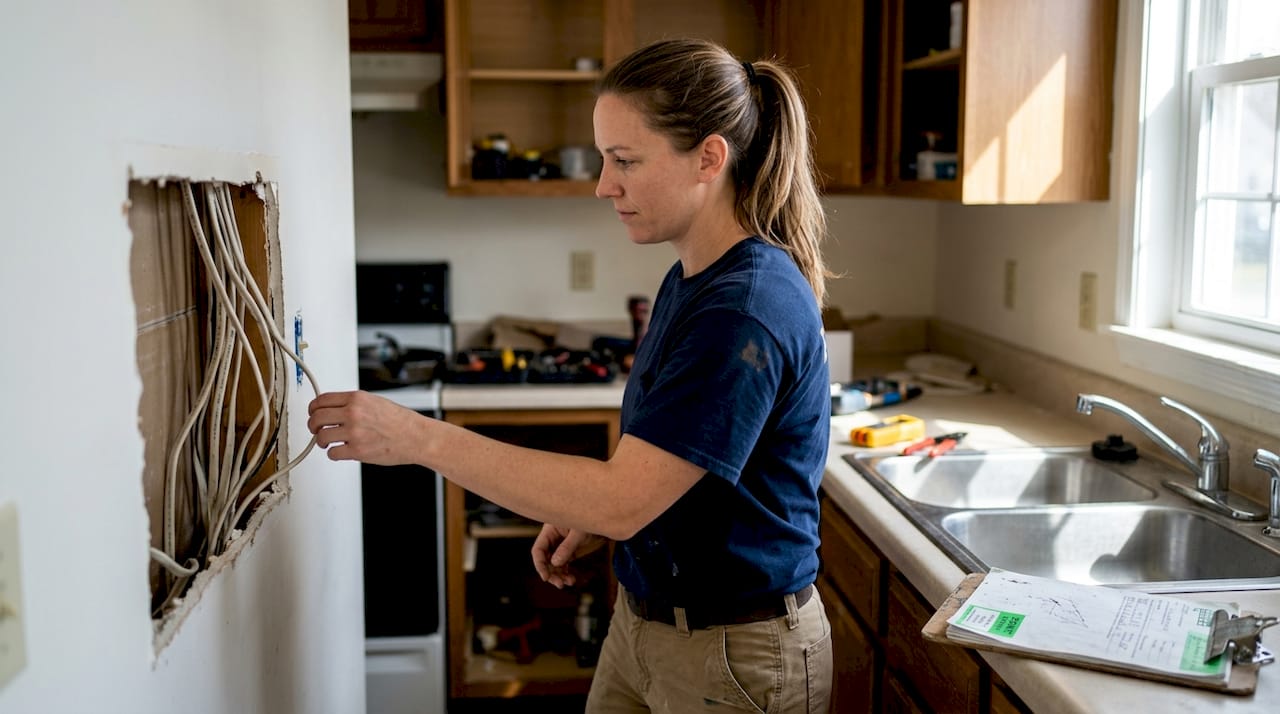
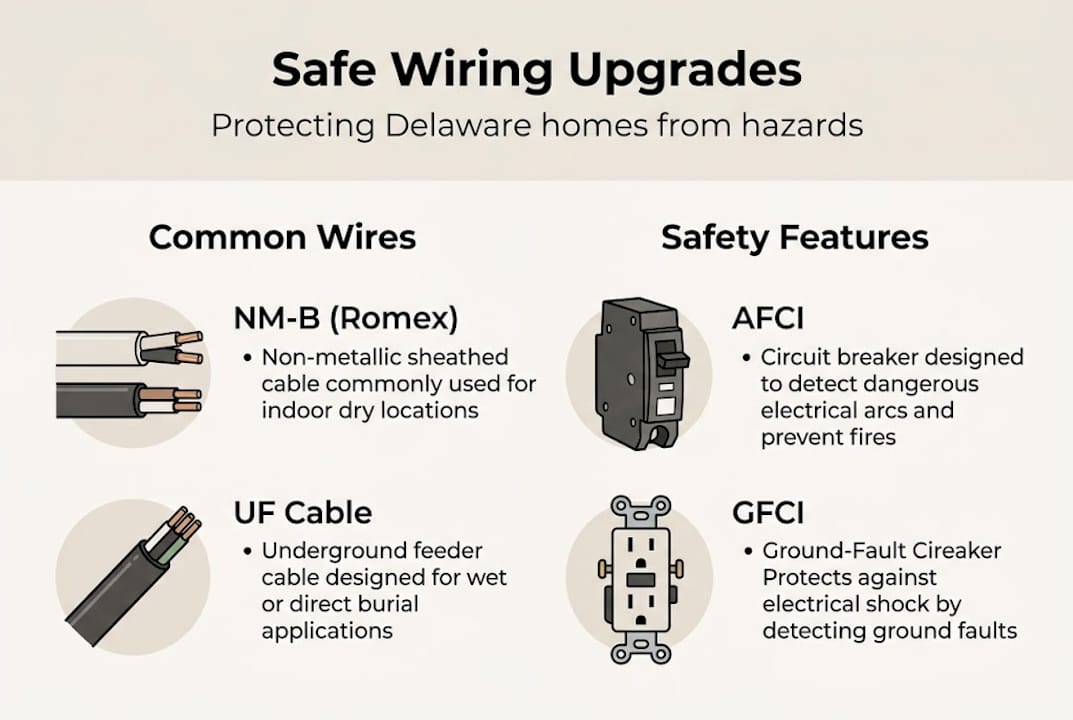
Open up a wall in most Delaware homes and you’ll likely find nonmetallic-sheathed cable, commonly called NM-B or Romex. This is the standard wiring method for dry indoor locations in wood-frame homes, secured every 4.5 feet and within 12 inches of electrical boxes. The wire gauge matters too: 14 AWG wire for 15-amp circuits, 12 AWG for 20-amp circuits. Using the wrong gauge is a serious fire hazard.
Not all locations allow NM-B cable. Garages, outdoor runs, and wet areas require conduit or underground feeder (UF) cable. Here’s a side-by-side comparison of the most common wiring methods:
| Wiring method | Best use | Key advantage |
|---|---|---|
| NM-B (Romex) | Dry indoor, wood-frame walls | Easy to install, cost-effective |
| EMT conduit | Exposed areas, garages | Mechanical protection |
| PVC conduit | Wet/outdoor locations | Corrosion resistant |
| MC/AC cable | Commercial, some residential | Metal armor protection |
| UF cable | Underground runs | Moisture and sunlight resistant |
For more detail on all approved options, the wiring methods and materials guide is a solid reference.
Two protection types every Delaware homeowner should know:
- GFCI (Ground Fault Circuit Interrupter): Required in kitchens, bathrooms, garages, and outdoors per NEC 210.8. It detects tiny current imbalances of about 5 milliamps and cuts power in milliseconds to prevent shock.
- AFCI (Arc Fault Circuit Interrupter): Required in most living areas per NEC 210.12. It detects dangerous arcing conditions that standard breakers miss, which is a leading cause of electrical fires.
Pro Tip: If your home was built before 2000, there’s a good chance your bedroom circuits lack AFCI protection. Upgrading to AFCI breakers is one of the most cost-effective safety improvements you can make.
Special locations like pools require additional protections. Pool wiring safety involves bonding, GFCI protection, and strict setback rules that go well beyond standard residential wiring.
Upgrading, repairing, and future-proofing your home wiring
Knowing what’s inside your walls is only useful if you act on it. Older Delaware homes often contain wiring that was acceptable decades ago but poses real risks today.
Knob-and-tube wiring (found in pre-1940 homes) is ungrounded and not code-compliant for new work. Aluminum branch wiring installed between 1965 and 1973 carries an overheating risk at connections and is also not approved for new installations. Both require upgrades, not just repairs.
Here’s a practical checklist for evaluating your home’s wiring:
- Does your panel have enough capacity? A 100 to 200-amp service at 120/240V is standard for modern homes.
- Are there double-tapped breakers (two wires on one breaker terminal)? This is a code violation.
- Do you have two-prong ungrounded outlets? These can’t support modern appliances safely.
- Are there any aluminum branch circuit wires at outlets or switches? Look for “AL” markings on wire insulation.
- Have you added major appliances, a home office, or an EV charger without upgrading the panel?
Steps to plan a smart upgrade:
- Audit your current load by listing all major appliances and their amperage
- Identify outdated wiring with help from a licensed electrician
- Upgrade the panel if your current service is under 200 amps
- Add dedicated circuits for high-draw appliances like dryers, EV chargers, and HVAC
- Install AFCI and GFCI protection where missing
- Plan future circuits now rather than tearing walls open twice
Pro Tip: When planning an EV charger installation, always add a 50-amp dedicated circuit even if you’re starting with a Level 1 charger. Upgrading later costs significantly more.
For homeowners unsure where to start, hiring a Wilmington electrician with experience in panel upgrades and older home rewiring takes the guesswork out of the process.
A new perspective: Rethinking home wiring for safety and value
Here’s something most homeowners don’t hear often enough: deferred electrical upgrades are not savings. They’re debts with interest.
We’ve worked in Delaware homes for over 20 years, and the pattern is consistent. A homeowner waits on a panel upgrade, then adds an EV charger, a hot tub, and a home office. Suddenly the panel is overloaded, circuits are doubled up, and what would have been a straightforward upgrade becomes a full rewire. The cost triples.
Delaware’s climate adds another layer most guides skip entirely. High summer humidity accelerates corrosion at connections. Coastal storm surges and frequent thunderstorms increase surge and arc fault risks. These aren’t theoretical concerns. They’re reasons why safe load calculations and proper grounding matter more here than in drier climates. Continuous loads must be derated to 125% of their rated amperage, a detail that gets missed in DIY work.
The homeowners who get the most value from their electrical systems are the ones who treat wiring as infrastructure, not an afterthought. A 200-amp panel with EV-ready circuits and proper bonding doesn’t just protect your family. It adds measurable value to your home and keeps you ahead of code changes. Review electrical safety tips year-round to stay proactive.
Safe wiring solutions for Delaware homes
If reading this has made you realize your home’s wiring needs attention, you’re already ahead of most homeowners.
Conductive Electrical Contracting has served Delaware homeowners for over 20 years with licensed electrical repairs that are fast, safe, and fully code-compliant. Whether you need a panel inspection, an upgrade to handle modern loads, or a full assessment of older wiring, our licensed team handles it with permits and inspections included. Check our panel upgrade guidance to understand what your home may need, and review common wiring problems solutions to spot issues before they become emergencies. Contact us today for a free estimate.
Frequently asked questions
Does Delaware require permits for changing home wiring?
Yes, permits and inspections are required for new circuits and major upgrades throughout Delaware, but minor replacements may be exempt depending on your local AHJ.
What is the safest wiring type for Delaware homes?
Nonmetallic-sheathed cable (NM-B/Romex) is safest for most dry indoor areas, but always use conduit for exposed or wet locations like garages and outdoor runs.
When should knob-and-tube or aluminum wiring be upgraded?
Both are not code-compliant for new work and carry real safety risks; upgrades are required rather than simple repairs for any significant electrical work in these homes.
Do Delaware homes need AFCI and GFCI protection?
Yes, AFCI protection is required in most living spaces and GFCI is required in kitchens, bathrooms, garages, and outdoors under NEC 210.8 and 210.12.